
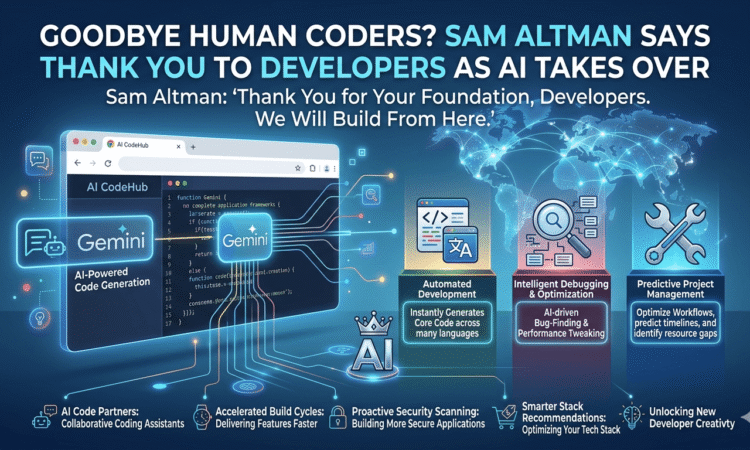
The Dawn of a New Era in Software Development
The tech world was sent into a frenzy when OpenAI CEO Sam Altman made statements suggesting a future where artificial intelligence could potentially replace human developers. As we stand at the crossroads of 2026, the question isn’t whether AI will transform coding—it’s how fast it will happen and what it means for millions of developers worldwide.
Is this the end of human coders, or the beginning of a new partnership with AI?
What Did Sam Altman Actually Say?
Sam Altman, the visionary behind ChatGPT and OpenAI’s groundbreaking AI models, has been increasingly vocal about AI’s role in software development. His message to developers has been both appreciative and sobering: Thank you for your service, but AI is ready to take the wheel.
Key Points from Altman’s Vision:
- AI coding assistants like GitHub Copilot, ChatGPT, and the upcoming GPT-5 are becoming increasingly sophisticated
- Agentic AI tools can now write entire applications with minimal human oversight
- The timeline is accelerating: What seemed decades away is now happening in months
- Automated testing and debugging powered by AI are streamlining development workflows
The Current State: AI Already Writing Code
The transformation isn’t coming—it’s already here. Let’s examine the evidence:
1. GitHub Copilot and Beyond
GitHub Copilot, powered by OpenAI’s technology, has evolved from a simple autocomplete tool to an intelligent pair programmer that:
- Writes entire functions based on comments
- Debugs complex code issues
- Suggests optimizations and refactoring
- Generates comprehensive test suites
2. Agentic AI Development
Recent breakthroughs in agentic AI coding tools mean that AI can now:
- Understand project requirements from natural language
- Design system architecture
- Write full-stack applications
- Deploy and maintain production systems
A notable example: Winston Chang’s work at RStudio demonstrated how Shiny applications can be built with React front-ends using AI tools, making complex web development accessible even to those with limited coding experience.
3. Automated Testing Revolution
AI is revolutionizing quality assurance:
- Automatic test generation for Shiny apps and other frameworks
- AI models trained on testing best practices
- Regression testing without manual intervention
- Coverage that would take human developers weeks to achieve
The Business Case: Why Companies Are Embracing AI Coders
AI-Run Organizations
We’re witnessing the emergence of AI-run organizations with minimal human employees:
- Tax advisory firms operating with AI accountants
- Law firms using AI for legal research and document drafting
- Software startups with AI handling end-to-end development
- Content production fully automated from ideation to publication
The Economic Reality
The numbers don’t lie:
| Traditional Development | AI-Assisted Development |
|---|---|
| Months of development time | Days or weeks |
| Teams of 5-10 developers | 1-2 developers + AI |
| $150K+ per developer salary | AI subscription: $20-200/month |
| Limited working hours | 24/7 availability |
What This Means for Human Developers
🔴 The Concerning Truth
Let’s not sugarcoat it—there are legitimate concerns:
- Entry-level positions disappearing: Junior developer roles that once trained the next generation may vanish
- Routine coding tasks obsolete: Stack Overflow questions answered instantly by AI
- Speed competition: Human developers can’t match AI’s output velocity
- Commoditization of code: Writing code becomes less valuable as AI does it faster
🟢 The Optimistic Perspective
But here’s why experienced developers shouldn’t panic:
- Higher-order thinking remains human: System design, architectural decisions, and business logic still need human insight
- Domain expertise is irreplaceable: Understanding healthcare, finance, or industry-specific problems requires human experience
- Creativity and innovation: AI can optimize and execute, but breakthrough ideas still come from humans
- Quality assurance: Someone needs to verify that AI-generated code actually works as intended
- Ethical oversight: AI can’t determine the moral implications of the software it creates
The “Swiss Cheese Model” of AI Development
According to AI safety research, no single solution is perfect—each has “holes.” But by stacking multiple imperfect solutions, we create a robust system. The same applies to AI in coding:
- AI generates the initial code (fast, but may have bugs)
- Human developers review and refine (slow, but catches edge cases)
- Automated testing validates functionality (comprehensive, but may miss user experience issues)
- User feedback drives improvements (real-world validation)
This multi-layered approach suggests that human-AI collaboration, not replacement, is the optimal path forward.
The Skills That Will Save Your Career
What to Learn NOW:
1. AI Prompt Engineering
Learn to communicate effectively with AI coding assistants. The best developers will be “AI whisperers” who can extract maximum value from these tools.
2. System Architecture
Focus on big-picture thinking: How do systems integrate? What are the security implications? How does it scale?
3. Domain Expertise
Become an expert in a specific industry: healthcare AI, financial systems, cybersecurity, or climate tech.
4. AI Tool Mastery
Master tools like:
- GitHub Copilot
- ChatGPT for development
- Anthropic’s Claude for code review
- Cursor IDE and other AI-native development environments
5. Soft Skills
Invest in skills AI can’t replicate:
- Client communication
- Project management
- Team leadership
- Business strategy
Real-World Applications: AI Coding in Action
Case Study 1: Healthcare Innovation
AI-guided drug discovery has revolutionized pharmaceutical development:
- AlphaFold 2 approximates protein structures in hours instead of months
- Machine learning accelerates Parkinson’s disease treatment research
- Initial screening is 10x faster and 1000x cheaper
Case Study 2: Cybersecurity
The WhiteRabbitNeo-13B model (a 13-billion parameter LLM) has been trained specifically for offensive and defensive cybersecurity, demonstrating how specialized AI models are emerging for niche technical domains.
Case Study 3: Web Development
Developers are now building full React + Shiny applications using agentic AI, even with minimal JavaScript knowledge—a task that previously required months of learning and practice.
The Governance Challenge: Who Controls AI Development?
As AI capabilities explode, critical questions emerge:
Technical Alignment
- How do we ensure AI writes secure, ethical code?
- Can we verify AI-generated code at scale?
- What happens when AI creates vulnerabilities we don’t understand?
Regulatory Landscape
Governments worldwide are grappling with AI regulation:
- EU AI Act: Comprehensive rules for AI development
- US Executive Orders: Guidelines for AI safety and testing
- Industry self-regulation: OpenAI’s safety board and similar initiatives
Whose Values?
When AI writes code that affects millions of users, whose values guide those decisions? This is the humane values problem in AI alignment.
The Timeline: When Will AI Fully “Take Over”?
2024-2025: The Foundation ✅ (Already Happening)
- AI coding assistants become standard tools
- 30-50% of code written by AI with human oversight
- Junior developer roles begin declining
2026-2027: The Acceleration 🔵 (Current Phase)
- GPT-5 and beyond: More capable reasoning and planning
- AI handles entire microservices and modules
- 60-80% of routine coding automated
- Shift to “AI supervisor” developer roles
2028-2030: The Transformation 🟡 (Emerging)
- AI systems can build production applications end-to-end
- Human developers focus primarily on architecture and strategy
- New job titles emerge: “AI System Designer,” “Code Curator,” “AI Ethics Officer”
- 90%+ of routine code generated by AI
2030+: The Unknown 🔴 (Speculation)
- AGI (Artificial General Intelligence) may emerge
- Fundamental restructuring of the software industry
- Potentially new paradigms we can’t yet imagine
Sam Altman’s Vision: A Paradox
Altman’s “thank you” to developers contains a fascinating paradox:
On one hand, he’s acknowledging that AI is rapidly approaching human-level coding capability.
On the other hand, OpenAI still employs thousands of engineers to build these AI systems. Even as AI becomes more capable, the need for elite engineers to push AI forward remains critical.
This suggests a bifurcation:
- Routine coding jobs: Increasingly automated
- Elite AI research and development roles: More valuable than ever
Action Plan: Future-Proofing Your Developer Career
Immediate Actions (Next 3 Months)
- Start using AI coding tools daily — Don’t resist, adapt
- Document your domain knowledge — Your industry expertise is valuable
- Learn one specialized field deeply — Become the expert AI consults
- Build your personal brand — Showcase your unique perspective
- Join AI + coding communities — Stay ahead of trends
Medium-term Strategy (6-12 Months)
- Take an AI/ML course — Understand the technology displacing you
- Contribute to open-source AI projects — Show you can work WITH AI
- Develop leadership skills — Position yourself as a team lead, not just a coder
- Create AI-assisted projects — Demonstrate 10x productivity with AI
- Network with AI researchers — Get insights from the source
Long-term Vision (1-3 Years)
- Pivot to AI-enhanced specializations — AI DevOps, AI Security, AI Ethics
- Consider entrepreneurship — AI makes starting a tech company cheaper than ever
- Invest in continuous learning — The field will keep evolving rapidly
- Build irreplaceable relationships — Human connection remains valuable
- Prepare for career pivots — Have a backup plan
The Bigger Picture: AI Transformation Beyond Coding
This isn’t just about developers. AI is transforming:
Creative Industries
- Generative AI art, music, and video: DALL-E, Midjourney, Sora
- Content creation: Automated journalism, blog writing, copywriting
- Personalization at scale: Every user gets custom content
Professional Services
- Legal research and document drafting: AI lawyers
- Medical diagnostics: AI detecting diseases earlier than doctors
- Financial analysis: AI traders and investment advisors
The Pattern
If your job can be broken down into repeatable patterns and logic, AI is coming for it. The question is: What will YOU do about it?
Conclusion: The Thank You That Changes Everything
Sam Altman’s “thank you” to developers is both a recognition of what humans have built and a signal of what’s coming. It’s not necessarily goodbye to human coders—but it is goodbye to coding as we’ve known it.
The Three Possible Futures:
🔴 Dystopian: Mass unemployment as AI replaces millions of developers, widening inequality.
🟡 Transitional: A messy decade of disruption, retraining, and adaptation as industries restructure.
🟢 Utopian: Humans elevated to higher-order work, freed from tedious tasks, partnering with AI to solve humanity’s greatest challenges.
Which future we get depends on choices we make today.
Final Thoughts: Adapt or Become Obsolete
The developers who thrive in the AI era won’t be those who can code the fastest—they’ll be those who can:
- Think at the system level
- Collaborate with AI effectively
- Solve problems AI can’t understand
- Build relationships AI can’t replace
- Create value beyond just writing code
Sam Altman’s thank you might feel premature, but it’s also a wake-up call. The question isn’t whether AI will change software development—it already has.
The question is: Will you be ready?