
The Hidden Power of Pokémon Go: How Niantic Is Building the Future of Spatial AI With Your Game Data
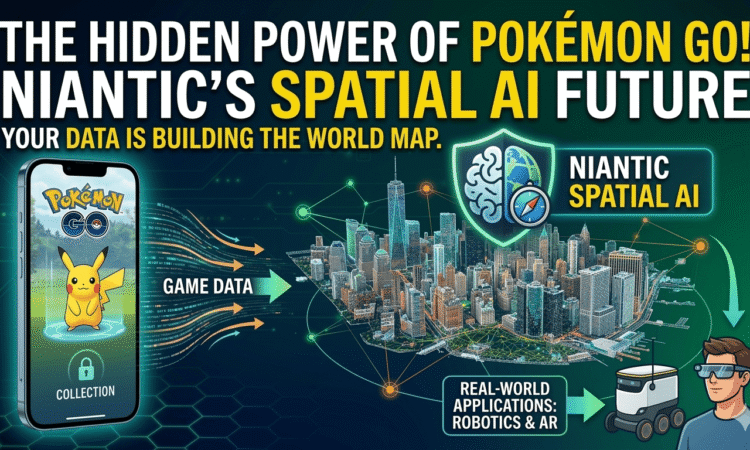
Niantic is using Pokémon Go player data to train Large Geospatial Models for delivery robots and AR. Discover how your gameplay is shaping AI’s future.
Introduction: Your Pokémon Hunt Is Training Tomorrow’s Robots
Remember catching that rare Pikachu in your local park? While you were celebrating your catch, you were also contributing to something far more significant: training artificial intelligence that could revolutionize robotics, autonomous vehicles, and augmented reality.
In November 2024, Niantic Labs—the company behind Pokémon Go—announced a groundbreaking initiative: they’re building a Large Geospatial Model (LGM) using data collected from millions of players worldwide. This isn’t just another AI project; it’s potentially the next evolution of how machines understand and navigate our physical world.
But what does this mean for players, privacy, and the future of technology? Let’s dive deep.
What Is Niantic’s Large Geospatial Model (LGM)?
Understanding Spatial Intelligence
Just as Large Language Models (LLMs) like ChatGPT learned to understand text by processing billions of documents, Niantic’s Large Geospatial Model aims to help AI understand physical spaces by processing millions of location-tagged images and scans.
Key Features of LGMs:
- 3D Scene Understanding: Goes beyond 2D maps to understand depth, objects, and spatial relationships
- Global Connectivity: Links millions of locations worldwide into a unified spatial network
- Predictive Capability: Can infer what spaces look like from limited angles or incomplete data
- Real-Time Processing: Processes spatial data for immediate navigation and interaction
How It Differs From Google Maps or Street View
| Feature | Google Maps/Street View | Niantic LGM |
|---|---|---|
| Data Type | Street-level panoramas | User-contributed 3D scans |
| Coverage | Roads and public areas | Pedestrian paths, parks, indoor spaces |
| Update Frequency | Periodic (months/years) | Continuous (real-time) |
| Detail Level | Building facades | Object-level detail (benches, trees, statues) |
| AI Training | Limited spatial reasoning | Advanced spatial intelligence |
How Pokémon Go Players Are Training AI (Without Knowing It)
The Data Collection Process
Every time you play Pokémon Go, you’re generating valuable geospatial data:
- Location Data: Your GPS coordinates as you move
- Visual Scans: When you use AR features, your phone camera captures the environment
- Mapping Contributions: Features like Niantic’s “Pokémon Playgrounds” require detailed scans of real-world locations
- Interaction Patterns: How you navigate through physical spaces
By 2024, Niantic had:
- Over 10 million scanned locations globally
- 1 million fresh scans added weekly
- 50+ million neural networks trained with over 150 trillion parameters
- Data from 100+ countries
Why This Data Is Invaluable
Unlike traditional mapping data:
- Pedestrian Perspective: Captured at eye level, not from cars or satellites
- Diverse Environments: Includes parks, trails, monuments—areas where vehicles can’t go
- Multi-Angle Coverage: Multiple players scan the same location from different perspectives
- Temporal Data: Shows how locations change over time (seasons, construction, events)
From Gaming to Robotics: Real-World Applications
1. Autonomous Delivery Robots
The immediate application that sparked headlines: delivery robots that can navigate complex pedestrian environments.
How LGMs Help:
- Navigate sidewalks, parks, and pedestrian-only zones
- Avoid obstacles like benches, trees, and temporary barriers
- Understand spatial context (e.g., “don’t cross through a playground”)
- Handle dynamic environments (crowds, weather conditions)
Industry Impact:
- Companies like Starship Technologies and Amazon Scout could benefit enormously
- Could reduce last-mile delivery costs by up to 40%
- Enable 24/7 autonomous delivery in urban areas
2. AR Glasses and Wearable Tech
Apple Vision Pro, Meta Quest, and future AR glasses need precise spatial understanding to overlay digital content on the real world.
Niantic’s LGM Advantage:
- Centimeter-level accuracy for digital object placement
- Persistent AR: Digital objects stay in the same real-world location for all users
- Contextual AR: Content adapts based on location and environment
3. Autonomous Vehicles
While companies like Waymo and Tesla focus on road-level autonomy, Niantic’s data covers the gaps:
- Pedestrian zones and walkways
- Parking lot navigation
- Campus and facility mapping
- Emergency vehicle routing through non-standard paths
4. Smart City Infrastructure
Urban planners and governments could use LGMs for:
- Traffic flow optimization
- Accessibility mapping for disabled individuals
- Emergency response planning
- Public space utilization analysis
5. Logistics and Supply Chain
Warehouse robots, inventory drones, and facility automation need detailed indoor mapping—exactly what Niantic’s crowdsourced data provides.
Privacy Concerns: Should Pokémon Go Players Be Worried?
What Data Does Niantic Collect?
According to Niantic’s privacy policy:
- ✅ Location data (GPS coordinates)
- ✅ Device information (phone model, OS)
- ✅ Camera images (when using AR features)
- ✅ Movement patterns and gameplay behavior
- ✅ Social interactions within the game
The Privacy Trade-Off
Arguments FOR data collection:
- Improves game experience (better AR, location-based events)
- Anonymous and aggregated data used for training
- Players consent via terms of service
- Advances beneficial technology (delivery robots, accessibility tools)
Arguments AGAINST:
- Lack of explicit consent for AI training purposes
- Potential for re-identification through pattern analysis
- Data shared with third parties or sold
- Unknown future uses of collected data
How to Protect Your Privacy
If you’re concerned but still want to play:
- Disable AR Mode: Turn off camera access in settings
- Limit Location Permissions: Use “While Using App” instead of “Always”
- Review Privacy Settings: Regularly check Niantic’s privacy dashboard
- Opt Out of Data Sharing: Contact Niantic support to limit data use
- Use a Burner Account: Separate gaming identity from personal accounts
The Competitive Landscape: Who Else Is Building Spatial AI?
Niantic isn’t alone in the spatial intelligence race:
Major Competitors
| Company | Technology | Data Source | Primary Application |
|---|---|---|---|
| Google Maps AI | Street View, Android devices | Navigation, AR (Google Lens) | |
| Apple | Apple Maps + ARKit | iPhone/iPad sensors | AR glasses, autonomous vehicles |
| Meta | Reality Labs AI | Quest headsets, Facebook photos | Metaverse, AR/VR |
| Microsoft | HoloLens Spatial Mapping | HoloLens users, Azure data | Enterprise AR, mixed reality |
| Nvidia | Omniverse AI | Simulation data | Robotics, autonomous systems |
Niantic’s Unique Advantage
Crowdsourced pedestrian-level data at scale—something no competitor has achieved. While Google has more data overall, Niantic has more detailed pedestrian-perspective information.
The Future: What Comes Next?
Short-Term (1-3 Years)
- Commercial partnerships with robotics and logistics companies
- Enhanced AR experiences in Niantic games
- Licensing LGM technology to third parties
- Expansion into indoor mapping (malls, airports, offices)
Medium-Term (3-5 Years)
- AR glasses integration (potentially partnering with Apple or Meta)
- Autonomous delivery robot fleets using Niantic maps
- Smart city implementations in pilot programs
- B2B geospatial AI services for enterprises
Long-Term (5-10 Years)
- Spatial operating system for AR/VR devices
- Global digital twin of pedestrian-accessible spaces
- AI-powered navigation for the visually impaired
- Metaverse infrastructure linking physical and digital worlds
Ethical Considerations and Regulatory Challenges
Key Ethical Questions
- Informed Consent: Did players knowingly agree to train AI systems?
- Data Ownership: Who owns the spatial data generated by users?
- Surveillance Implications: Could LGMs enable mass surveillance?
- Bias and Accessibility: Will models reflect urban vs. rural biases?
- Dual-Use Technology: Could military applications emerge?
Regulatory Landscape
Current regulations that apply:
- GDPR (Europe): Requires explicit consent for data processing
- CCPA (California): Gives users rights to know and delete data
- COPPA (US): Protects children’s data (Pokémon Go has young players)
Potential future regulations:
- Specific laws for geospatial AI data collection
- Requirements for transparency in AI training data sources
- Limitations on commercial use of crowdsourced data
Expert Opinions and Industry Reactions
“Niantic’s approach is brilliant—they’ve gamified the most expensive part of building spatial AI: data collection.” — Dr. Sarah Chen, AI Researcher, MIT
“This raises serious questions about consent. Players thought they were catching Pokémon, not training robots.” — Privacy Advocate John Mitchell, EFF
“The potential for delivery robots, AR, and accessibility tools is enormous. This could genuinely improve lives.” — Robotics Engineer Maria Rodriguez, Amazon Robotics
Comparison: Niantic LGM vs. Other Foundation Models
| Model Type | Example | Training Data | Primary Function | Application |
|---|---|---|---|---|
| Large Language Model (LLM) | ChatGPT, GPT-4 | Text (books, websites) | Understand & generate language | Chatbots, writing, coding |
| Large Vision Model (LVM) | DALL-E, Midjourney | Images & descriptions | Generate & analyze images | Art creation, image recognition |
| Large Geospatial Model (LGM) | Niantic LGM | Location-tagged 3D scans | Understand physical spaces | Robotics, AR, navigation |
The LGM represents the “missing link” between digital AI and physical-world applications.
How This Affects the Gaming Industry.
New Business Models
- Data Monetization: Games as data collection platforms
- B2B Licensing: Selling AI models to enterprises
- Platform Services: Providing spatial AI infrastructure
Implications for Players
- Better AR experiences in future games
- Privacy concerns may lead to player backlash
- Value exchange: Players want compensation or benefits for contributing data
- Competitive advantage: Games with AI integration may dominate
Industry Precedents
- reCAPTCHA: Trained Google’s OCR and image recognition AI
- Duolingo: Crowdsourced translation data while teaching languages
- Waze: Collected traffic data through user reports
Niantic’s model could become the blueprint for future mobile game development.
Actionable Insights for Stakeholders
For Pokémon Go Players
- ✅ Stay informed about privacy settings
- ✅ Understand what data you’re sharing
- ✅ Consider the trade-offs between privacy and gameplay
- ✅ Advocate for transparent data policies
For Businesses
- ✅ Explore partnerships with Niantic for spatial AI applications
- ✅ Consider how LGMs could enhance your products/services
- ✅ Invest in spatial AI research and development
- ✅ Prepare for a spatially-aware digital future
For Policymakers
- ✅ Develop clear regulations for geospatial AI data collection
- ✅ Ensure informed consent mechanisms are robust
- ✅ Balance innovation with privacy protection
- ✅ Support research into ethical AI development
For Investors
- ✅ Monitor Niantic’s commercialization strategy
- ✅ Watch for robotics/logistics companies partnering with spatial AI providers
- ✅ Consider AR/VR companies that could benefit from LGM technology
- ✅ Assess privacy-focused alternatives as potential disruptors
Frequently Asked Questions (FAQs)
1. Is Niantic selling my Pokémon Go data?
Niantic states that data is anonymized and aggregated for AI training, not sold individually. However, they may license the trained AI models to partners.
2. Can I opt out of AI training while still playing?
Currently, opting out completely while playing is difficult. You can limit data sharing by disabling AR features and restricting location permissions.
3. Will delivery robots trained on this data replace human jobs?
Potentially, yes—but they may also create new jobs in robot maintenance, AI training, and fleet management. The net employment impact is debated.
4. How accurate is Niantic’s spatial AI?
Niantic’s Visual Positioning System (VPS) achieves centimeter-level accuracy, far superior to GPS (which is accurate to ~5 meters).
5. Could this technology be used for surveillance?
Theoretically, yes—but Niantic emphasizes that data is anonymized. Regulatory oversight will be crucial to prevent misuse.
6. When will we see products using this technology?
Early applications (delivery robots, enhanced AR games) could appear within 1-2 years. Mass-market AR glasses might take 3-5 years.
7. How does this compare to Tesla’s FSD data collection?
Tesla collects road-level data from drivers; Niantic collects pedestrian-level data from gamers. They’re complementary datasets for different use cases.
Conclusion: The Double-Edged Sword of Innovation
Niantic’s use of Pokémon Go data to train spatial AI represents both an incredible technological opportunity and a significant privacy challenge.
The Upside:
- Revolutionary advances in robotics, AR, and autonomous systems
- Improved accessibility tools for disabled individuals
- Enhanced navigation and smart city applications
- Economic opportunities in AI-driven industries
The Downside:
- Privacy concerns and lack of explicit consent
- Potential for surveillance and data misuse
- Concentration of spatial data in corporate hands
- Ethical questions about data ownership
The key question isn’t whether this technology will advance—it will. The question is whether it will advance responsibly, with adequate protections for user privacy and informed consent.
As players, consumers, and citizens, we must demand transparency, ethical practices, and regulatory oversight while remaining open to the genuine benefits spatial AI can bring.