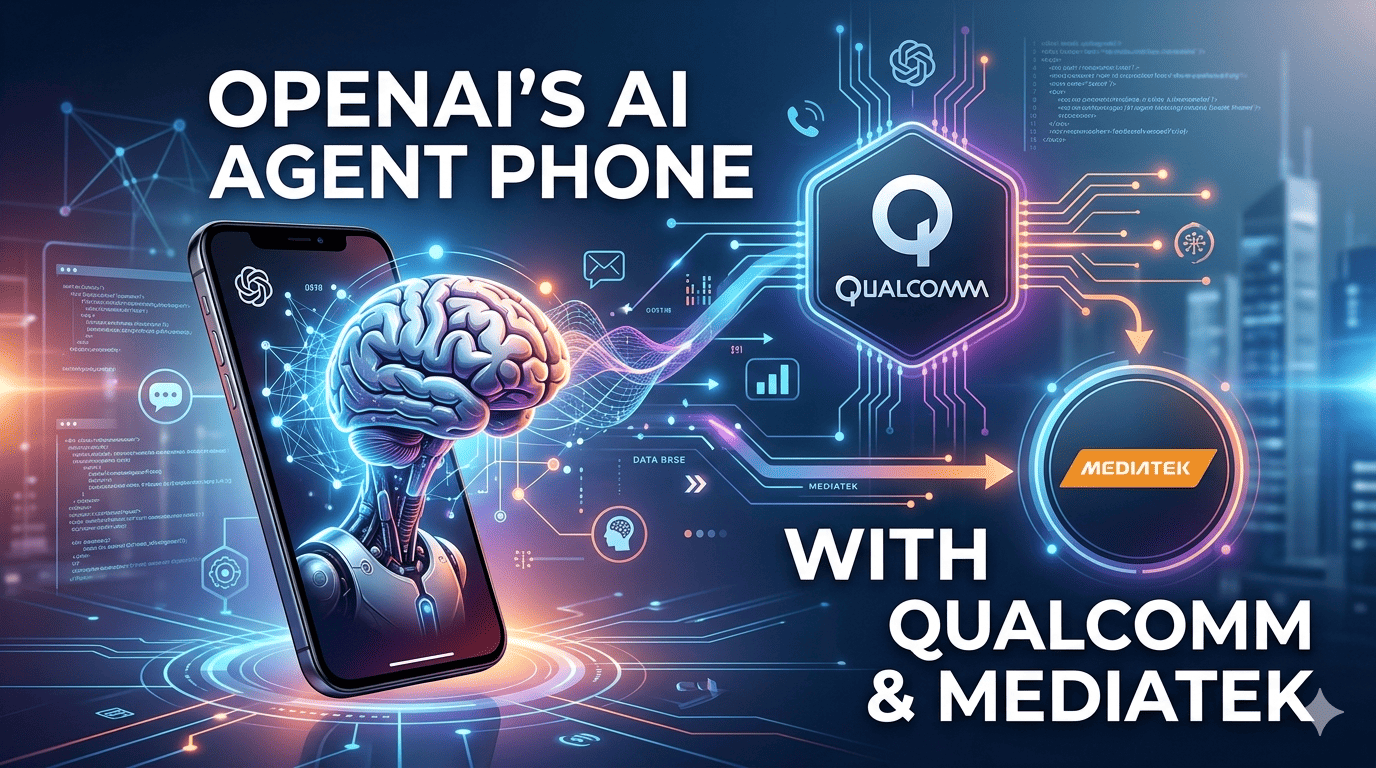
OpenAI Smartphone development is now officially underway. On April 27, 2026, analyst Ming-Chi Kuo revealed that OpenAI is co-developing a custom chip with Qualcomm and MediaTek, with Luxshare as exclusive manufacturing partner — targeting mass production by 2028.
OpenAI is building an AI agent smartphone that kills the app model entirely — partnering with Qualcomm, MediaTek, and Luxshare. Here’s everything you need to know, from custom chips to what it means for your iPhone.
On April 27, 2026, one of the most credible names in tech hardware analysis dropped a bombshell. Ming-Chi Kuo, the TF International Securities analyst whose Apple supply-chain intelligence has consistently proven accurate, posted on X that OpenAI is co-developing a custom smartphone chip with Qualcomm and MediaTek, with Luxshare as the exclusive system co-design and manufacturing partner.
Markets responded immediately. Qualcomm (QCOM) stock surged as much as 12% intraday, almost wiping out its entire 2026 loss in a single session. The reason? This is not a rumor about a startup — it’s a credible supply-chain signal about the most talked-about AI company on earth entering the hardware business at a scale that would rival Apple’s iPhone.
This guide breaks down every confirmed detail, what it means for consumers, investors, and the smartphone industry — and what the top-ranked articles are not yet telling you.
1. What Is the OpenAI Smartphone? The AI Agent Phone Explained?
This is not a phone with a ChatGPT icon on the home screen. According to Kuo’s report, the device is conceptually different from every smartphone currently on the market. The core principle: replace apps entirely with AI agents.
On every phone today — iPhone, Galaxy, Pixel — you open an app to accomplish a task. You open Maps for navigation, Gmail for email, Spotify for music. The app is the interface. The OpenAI phone proposes to eliminate this entirely. Instead of a grid of icons, you interact with a single AI agent layer that understands your goal and executes it — booking a restaurant, sending an email, playing music — without you ever manually touching a single app.
| Kuo’s Core Argument
“Users don’t want to use a collection of apps — they want to accomplish tasks and satisfy needs. Only by fully controlling both the operating system and hardware can OpenAI deliver a comprehensive AI agent service.” — Ming-Chi Kuo, TF International Securities |
This approach would also sidestep one of OpenAI’s biggest current frustrations: system-level restrictions. When ChatGPT runs on iOS or Android, Apple and Google control what the AI can access — your calendar, contacts, camera, health data. A native OpenAI operating system would remove those gatekeepers entirely.
Cloud AI + On-Device AI: A Hybrid Architecture
The phone would integrate both cloud-based and edge AI. Simple, low-latency tasks — setting alarms, reading local files, basic queries — would be processed directly on the device for privacy and speed. Complex, computationally heavy requests would route to OpenAI’s cloud models (GPT-4o, o3, and successors). This hybrid approach mirrors what Apple Intelligence does today, but built entirely around OpenAI’s own model ecosystem.
2. Why the OpenAI Smartphone Uses Both Qualcomm + MediaTek Custom Chip?
The choice of two chip partners — and Luxshare as the exclusive manufacturer — is the most technically significant aspect of this report. Here is what each partner brings to the table:
Qualcomm’s Role
Qualcomm is not just the dominant smartphone chip maker — it is increasingly an AI infrastructure company. The Snapdragon 8 Elite Gen 5 already powers 75% of Samsung’s Galaxy S26 series and has, for the first time, outperformed Apple’s chips in multi-core and GPU benchmarks. Its Hexagon NPU delivers 37% faster AI processing than its predecessor and supports what Qualcomm calls “agentic AI” — systems that learn from user behaviour and maintain a personal knowledge graph. Qualcomm is also preparing its own 2nm chipset for late 2026, directly aligned with OpenAI’s 2028 production timeline.
MediaTek’s Role
MediaTek’s Dimensity 9500 already matches Qualcomm and Apple in CPU performance at a lower cost with better power efficiency. Critically, MediaTek completed tape-out of its first 2nm flagship SoC in late 2025 — ahead of Qualcomm. For OpenAI, having MediaTek as a second chip partner means competitive pricing leverage, supply redundancy, and access to cost-optimized silicon for markets like India where price sensitivity is high.
Luxshare as Exclusive Manufacturing Partner
Luxshare Precision Industry assembles AirPods and Apple Watch components and has been gaining an increasing share of iPhone assembly — the exact supply-chain footprint needed for a device targeting hundreds of millions of units. Kuo describes Luxshare’s exclusive co-design and manufacturing role as particularly significant, positioning it to potentially become for OpenAI what Foxconn is for Apple.
| Investment Signal
These are not vaporware suppliers. Luxshare builds Apple products at scale. Qualcomm powers flagship Android devices globally. MediaTek leads emerging market premium devices. The supply chain credibility here is unusually strong for an unannounced product. |
3. OpenAI’s Full Hardware Roadmap: 5 Devices, 2026–2028
The AI agent phone is one piece of a larger hardware ambition. In January 2026, OpenAI disclosed a five-device hardware roadmap. Here is the full known timeline:
| Timeline | Product | Details |
| September 2026 | Sweetpea Earbuds | OpenAI’s first consumer hardware product. Earbuds with direct ChatGPT integration. First real-world test of OpenAI’s ability to ship hardware on schedule. |
| Early 2027 | Jony Ive “Screen-less” AI Device | Palm-sized, screenless device with camera, microphone, speaker, and small projector. Always-on. Designed by Jony Ive (ex-Apple). Built by Foxconn. |
| 2027–2028 | Smart Glasses, Wearable AI Pin, Digital Voice Recorder | Additional form factors completing the OpenAI hardware ecosystem. Details unconfirmed but part of the five-device roadmap. |
| 2028 | OpenAI AI Agent Smartphone | Mass production begins. Qualcomm + MediaTek custom chip. Luxshare exclusive manufacturing. 300–400M annual unit target. App-free AI agent interface. |
4. OpenAI Smartphone vs iPhone vs Samsung: Head-to-Head Comparison
The following comparison is based on confirmed and reported specifications as of April 2026. OpenAI columns reflect analyst projections, not official announcements.
| Feature | OpenAI AI Phone (2028) | Apple iPhone (2026) | Samsung Galaxy S26 |
| Custom Silicon | In development (Qualcomm + MediaTek joint) | Apple A-series (fully owned) | Qualcomm + Exynos (split) |
| AI Model Integration | OpenAI GPT + on-device models | Apple Intelligence + Siri | Galaxy AI + Gemini |
| App Ecosystem | Agent-first: apps hidden from users | App Store: 2M+ apps | Google Play: 3M+ apps |
| Operating System | Proprietary (in development) | iOS (fully owned + 20yr history) | Android / OneUI (partial ownership) |
| Hardware Experience | None — first device ships 2026 | 20+ years | 15+ years |
| Carrier Distribution | Not yet established | Global carrier partnerships | Global carrier partnerships |
| Manufacturing Partner | Luxshare (exclusive) | Foxconn + Luxshare (dual) | Samsung SDC in-house |
5. The Real Challenges: Why This Could Fail
Every credible analysis of this story must address a hard truth: no new smartphone platform has succeeded since Android and iOS. Microsoft tried with Windows Phone and failed. Samsung tried with Tizen and abandoned it. Amazon’s Fire Phone was discontinued within 13 months.
The App Gap Problem
OpenAI’s agent-first architecture is precisely designed to avoid the app gap trap that killed Windows Phone — where developers wouldn’t build apps because users weren’t there, and users wouldn’t switch because there were no apps. By making apps irrelevant, OpenAI doesn’t need a developer ecosystem. But it must deliver an AI agent that is genuinely capable of replacing every app a user relies on daily.
The Distribution Problem
Apple and Google have direct relationships with hundreds of mobile carriers worldwide. Getting an OpenAI phone on a carrier’s shelves — with subsidies, data plans, and promotional real estate — takes years to negotiate. OpenAI has none of this. The 2028 timeline gives them roughly two years to build what incumbents took a decade to create.
The Track Record Problem
AI hardware has a brutal track record. The Humane AI Pin launched in 2024 to poor reviews and was permanently shut down in February 2025 when HP acquired its remains for $116 million. Rabbit’s R1 shipped to rapidly declining consumer interest. Both tried to replace the smartphone. Both failed. OpenAI’s advantage is that it has something those products lacked: an AI model that actually works at scale, used by 400 million people weekly.
| Key Risk to Watch
The Sweetpea earbuds (September 2026) will be OpenAI’s first hardware test. If they deliver on time and quality, MediaTek, Qualcomm, and Luxshare will likely commit final production capacity to the smartphone. If not, the entire 2028 timeline is at serious risk. |
6. What It Means for Consumers, Developers & Investors
For Consumers
If OpenAI delivers, the user experience could be genuinely transformative. Imagine describing what you need — “book me a table for two at a good Italian restaurant near me on Saturday at 8pm, within my usual budget” — and having it completed with one sentence, no app-switching, no searching. OpenAI is the first company with both the model quality and brand trust to attempt this at smartphone scale.
For Developers
The move would disrupt the entire app economy. If users never manually open apps, the 30-year paradigm of app discovery, downloads, and in-app purchases collapses. OpenAI has hinted at creating a new AI agent ecosystem for developers — essentially, developers would build agents, not apps. Early positioning in an OpenAI agent marketplace could be the 2028 equivalent of building an early iPhone app in 2008.
For Investors
Qualcomm’s 12% single-day surge tells the story clearly. The market sees this as a massive new revenue stream for QCOM in a period when its Android OEM business faces pressure from Apple’s custom modem development and MediaTek’s premium encroachment. MediaTek stands to gain equally. Luxshare’s exclusive manufacturing role could mirror its Apple relationship — a multi-billion-dollar, multi-year contract. Note: this is not financial advice. Always consult a financial advisor before investing.
7. Frequently Asked Questions (FAQ)
Has OpenAI officially confirmed the smartphone?
No. As of April 28, 2026, OpenAI has not confirmed the smartphone program. The report comes from analyst Ming-Chi Kuo of TF International Securities. Qualcomm, MediaTek, and Luxshare have also not commented. OpenAI did not respond to media requests for comment.
When will the OpenAI phone be released?
According to Kuo’s report, mass production is targeted for 2028, with supplier relationships expected to be finalized by late 2026 or early 2027. No official release date has been announced. The earliest consumer availability would likely be late 2028 or early 2029.
What operating system will the OpenAI phone run?
Kuo argues that OpenAI must build its own operating system to deliver full AI agent functionality. Running on iOS or Android would keep OpenAI constrained by Apple’s and Google’s system-level permissions. The specifics of the OS are not yet disclosed publicly.
How much will the OpenAI phone cost?
No pricing has been discussed. However, Kuo suggested OpenAI could bundle device hardware with a ChatGPT subscription — a model similar to how Amazon subsidizes Kindle hardware to lock in Prime subscribers. A subsidized hardware model could make the device surprisingly affordable at launch.
Is the OpenAI phone the same as the Jony Ive device?
No. These are two separate hardware tracks. The Jony Ive device (from the $6.4B acquisition of io in May 2025) is a non-phone, screen-less device expected in early 2027, built by Foxconn. The smartphone (this article’s subject) is a separate program with Qualcomm, MediaTek, and Luxshare targeting 2028.
Will the OpenAI phone be available in India and emerging markets?
The dual-chip strategy (Qualcomm for premium, MediaTek for cost-optimized) strongly suggests a multi-tier pricing approach designed to compete globally — including cost-sensitive markets like India, Southeast Asia, and Brazil. MediaTek has dominant market share in exactly these regions, which is likely a strategic reason for its inclusion.
Should I buy Qualcomm or MediaTek stock based on this news?
This article is not financial advice. Qualcomm surged 12% intraday on the unconfirmed Kuo report. The timeline is 2028, the partnership is unconfirmed, and significant execution risk remains. The market clearly sees it as a positive signal, but always consult a qualified financial advisor before making investment decisions.
The Bottom Line
The OpenAI AI agent phone, if it materializes, would be the most significant attempt to disrupt the smartphone duopoly since Android challenged the iPhone in 2008. The supply chain is credible. The ambition is extraordinary. The obstacles are real.
What makes this different from every previous smartphone challenger is the combination of factors OpenAI brings: 400 million weekly active users who already use its AI daily, a model capability that genuinely outperforms Siri and Google Assistant at complex tasks, a hardware design partner in Jony Ive whose aesthetic track record is unmatched, and now a chip development program with the two most capable mobile silicon companies on earth.
The Sweetpea earbuds in September 2026 will be the first real signal. Watch that launch closely — it will tell you everything about whether the 2028 smartphone is a product or a press release.