
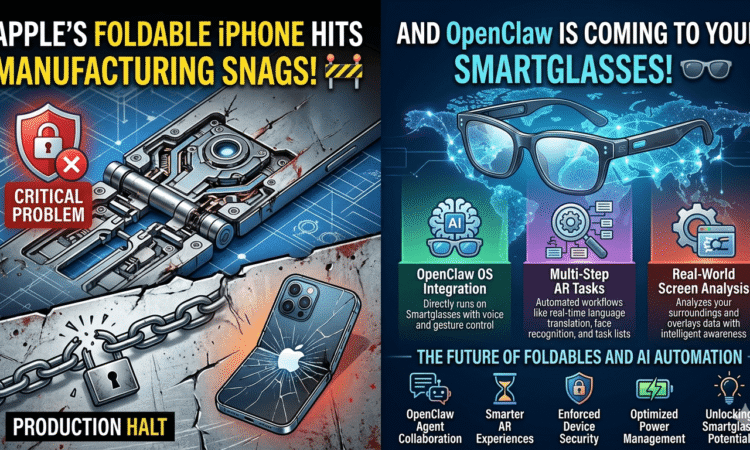
Apple’s most ambitious iPhone in a decade faces late-stage production turbulence, while an open-source AI agent platform prepares to launch on wearable glasses. Here is every critical detail from this week’s biggest tech news.
What Is Happening Right Now
Two major stories are shaping the tech landscape this week: Apple’s long-awaited foldable iPhone is encountering real-world engineering friction, and OpenClaw — the AI agent platform Jensen Huang called “the next ChatGPT” — is about to make AI wearables dramatically more capable.
This is not a slow news week. Within 48 hours, Nikkei Asia reported Apple’s foldable was at risk of delay, Bloomberg’s Mark Gurman countered that it remains on track for September, Chinese leakers revealed the true nature of the production snags, and Rokid announced OpenClaw integration for its AI smartglasses. Let’s break it all down clearly.
Key Takeaway
Apple’s foldable iPhone is not delayed yet — but it faces real friction around hinge materials and supplier pricing. Meanwhile, OpenClaw’s arrival on smartglasses is a genuine inflection point for AI wearables.
Apple’s Foldable iPhone Manufacturing Snags: The Full Story
Apple’s first foldable iPhone — widely referred to as the iPhone Fold, though leakers now suggest it may launch as the iPhone Ultra — is in a genuinely critical moment. The device is further along in development than most realize, but it has hit friction at the worst possible time: the final engineering stretch before mass production.
What Nikkei Asia First Reported
Nikkei Asia’s initial report triggered alarm across the tech press, stating that “the current solutions are not enough to completely solve the engineering challenge” and that “April will mark a crucial stage of the engineering verification test, and this month till early May is extremely critical.” Sources told Nikkei that component suppliers had already been notified of a potentially delayed production schedule.
What the Snags Actually Are (And Are Not)
Here is where it gets more nuanced. Chinese leaker Fixed Focus Digital — who correctly called the iPhone 16e name ahead of launch — provided more granular detail. According to their supply chain sources:
- The display is NOT the problem. Apple has reportedly secured foldable OLED panels exclusively from Samsung Display using CoE (Color filter on Encapsulation) technology, which eliminates the polarizer and reduces crease visibility. That deal is locked in for three years.
- The hinge material is still undecided. Apple is reportedly choosing between liquid metal and 3D-printed titanium alloy. Liquid metal could improve durability and further reduce creasing; titanium alloy has precedent (it was used in the iPhone Air). This decision is expected to be finalized during the Production Validation Test (PVT) phase in July–August 2026.
- Supplier pricing negotiations are stalled. Apple and its assembly partner(s) have not agreed on manufacturing costs, which directly affects both the production timeline and the final retail price.
Apple and its suppliers cannot seem to agree on the iPhone Fold’s materials and prices. Both entities are at an impasse, which may delay mass manufacturing — and every passing day shrinks the window.
— WccfTech, citing supply chain sources, April 2026
Bloomberg Counters: September Is Still the Target
Bloomberg’s Mark Gurman — the most consistently accurate Apple reporter in the business — pushed back. His sources confirmed the foldable iPhone is still scheduled to debut in September alongside the iPhone 18 Pro and Pro Max. The catch: initial supply may be constrained for several weeks due to the complexity of the device. Gurman is clear that six months out, nothing is fully final — but there is no confirmed delay.
Status as of April 10, 2026
The iPhone Fold / iPhone Ultra is still officially on track for September 2026, per Bloomberg. The PVT phase in July–August is the next critical checkpoint. If unresolved issues persist through that window, a slip to late 2026 or even 2027 becomes materially possible.
Why Apple Cut Initial Shipment Targets
Separate from the snag reports, Apple has reportedly reduced its initial shipment target from 10 million units down to approximately 3 million units for 2026. While that sounds alarming, context matters: Samsung’s Galaxy Z Fold 7 — the market leader on its seventh generation — was initially projected to ship around 2.4 million book-style units. Apple entering at 3 million, even amid constraints, would be a stronger debut than Samsung’s most recent flagship foldable.
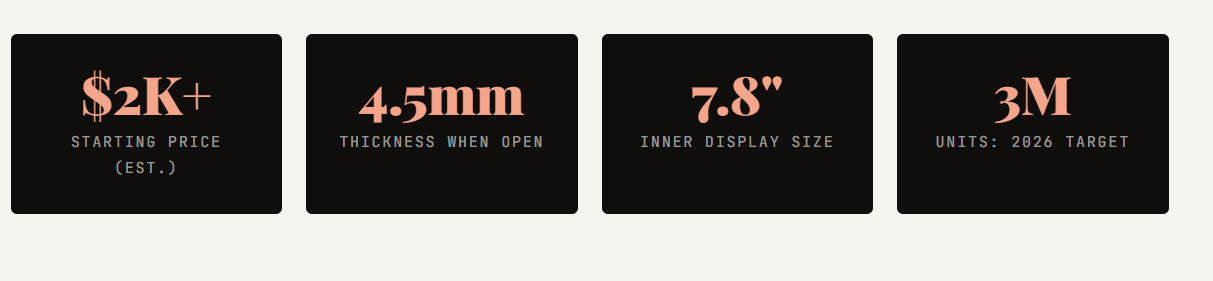
iPhone Fold / iPhone Ultra — All Known Specs
Based on consolidated reports from Bloomberg, MacRumors, Ming-Chi Kuo, and multiple supply chain sources, here is the most complete spec picture available today:
| Specification | Detail | Confidence |
|---|---|---|
| Name | iPhone Fold or iPhone Ultra (TBC) | Medium |
| Form Factor | Book-style, wider than tall (4:3 ratio) | High |
| Inner Display | ~7.8-inch OLED (iPad mini-sized), 120Hz | High |
| Outer Display | ~5.5-inch cover screen | High |
| Thickness (Open) | ~4.5mm (thinnest Apple device ever) | High |
| Thickness (Closed) | ~9–9.5mm | High |
| Chipset | A20 Pro | Medium |
| Display Supplier | Samsung Display (CoE OLED, 3-year exclusive) | High |
| Hinge Material | Liquid metal OR 3D-printed titanium alloy (undecided) | Confirmed Undecided |
| Frame | Titanium and aluminum combination | High |
| Cameras (Rear) | 2 cameras (no telephoto) | High |
| Face ID | No — replaced by Touch ID power button | High |
| Starting Price | $2,000–$2,500 (maxed: ~$3,000) | Medium-High |
| Launch Target | September 2026 (alongside iPhone 18 Pro) | High (Bloomberg) |
| Initial Supply | ~3 million units (reduced from 10M) | Medium |
✅ What Apple Has Solved
Apple has reportedly resolved screen crease quality (using Samsung’s CoE OLED technology) and overall display integration. The hinge crease is described as reduced to “near-invisible” rather than fully eliminated — a realistic achievement. Trial production at Foxconn has also begun.
iPhone Fold Production & Launch Timeline
Early April 2026 — Trial Production Begins at Foxconn Foxconn starts trial production — an early pre-mass-production validation stage. Trial production comes before mass production, which Apple plans to start in July as long as no issues arise during the earlier testing stage.
April – May 2026 — 🔴 Critical Engineering Verification Window Nikkei’s sources describe this period as “extremely critical.” Apple must resolve hinge material selection and supplier pricing during this window.
July 2026 (Target) — Mass Production Begins If no issues persist, Apple intends to begin mass production. Hinge material must be finalized no later than the PVT phase.
July – August 2026 — Production Validation Test (PVT) Fixed Focus Digital expects Apple to settle on its preferred hinge material during the PVT phase between July and early August — the latest point at which such a decision can realistically be made while keeping a 2026 ship date.
September 2026 — 🎯 Target Launch Event The foldable model is scheduled to be introduced in September alongside the iPhone 18 Pro and Pro Max. Apple’s phones typically hit store shelves the week after they are unveiled.
December 2026 (Contingency) Some leakers suggest the foldable could launch as late as December 2026 if engineering issues are not resolved in time for the September window
iPhone Fold vs. Samsung Galaxy Z Fold 7
| Feature | iPhone Fold / Ultra | Samsung Galaxy Z Fold 7 |
|---|---|---|
| Inner Display | ~7.8″ OLED (4:3 ratio) | ~8.0″ AMOLED |
| Cover Display | ~5.5″ | ~6.5″ |
| Thickness (Open) | ✅ ~4.5mm | ~5.6mm |
| Crease Visibility | ✅ Near-invisible | Visible crease |
| Face Unlock | ❌ No (Touch ID only) | ✅ Yes |
| Rear Cameras | 2 (no telephoto) | ✅ 3 (telephoto included) |
| Generation | 1st (Apple) | 7th (Samsung) |
| Starting Price | ~$2,000+ | ~$1,899 |
| Ecosystem | ✅ iOS / iPadOS apps | Android |
| Initial Supply (est.) | ~3M units | ~2.4M units |
Apple’s key differentiators are its much thinner profile, near-crease-free display, and the ability to run iPad apps natively on the unfolded screen. The device will look like a hybrid between an iPhone and an iPad, with iPad-like functionality when unfolded.
Samsung still leads on camera versatility and Face ID-equivalent biometrics. This is, however, Apple’s first generation — Samsung was on its seventh before the Galaxy Fold felt truly polished.
OpenClaw Is Coming to Smartglasses — Here’s Why It Matters
OpenClaw — the open-source AI agent platform that Nvidia’s Jensen Huang called “the next ChatGPT” — is about to leave your desktop and land on your face. Chinese smartglasses startup Rokid has announced it will integrate OpenClaw directly into its AI glasses platform.
What Is OpenClaw?
OpenClaw was built by Austrian programmer Peter Steinberger in late 2025 while experimenting with AI coding tools to organize his own digital life. The result was something few anticipated: an open-source agent framework that lets users create autonomous “claws” — autonomous agents that can execute complex, multi-step real-world tasks like managing email, browsing the web, booking flights, managing smart home devices, writing code, and more.
After Jensen Huang publicly praised it, OpenAI’s Sam Altman hired Steinberger directly to lead personal agent development. OpenClaw currently has over 56 skills and an active global developer community with thousands of custom integrations.
2023-2024 was the year of ChatGPT, last year was the year of the coding agent, this year’s going to be the year of the general agent.
— Peter Steinberger, OpenClaw creator, Tokyo ClawCon 2026
How Rokid Is Bringing OpenClaw to Smartglasses
Chinese startup Rokid is integrating OpenClaw into its smartglasses platform with a “one-click” deployment model. Users will be able to summon AI agents entirely by voice, without needing to touch a phone or computer. Rokid’s global senior director of product, engineering and ecosystem Weiqi Zhao explained the rationale directly to Nikkei Asia:
AI glasses are a natural platform to host AI agents, and an AI agent is a great catalyst to accelerate the adoption of AI glasses.
— Weiqi Zhao, Rokid, April 2026
The integration works through what Rokid calls a “claw assistant layer” that sits on the device and enforces safety and stability as a primary constraint, even at the cost of some agent capability. Users wearing Rokid glasses with a microphone and camera get persistent voice access to OpenClaw’s full suite of skills — web search, messaging, calendar management, file operations, and more — while physically moving through the world.
VisionClaw: OpenClaw Already Running on Meta Ray-Bans
The Rokid integration is the enterprise-grade story, but grassroots developers have already been running OpenClaw on Meta Ray-Ban glasses via an open-source project called VisionClaw, built by developer Xiaoan (Sean) Liu. VisionClaw connects Meta Ray-Ban glasses to Google’s Gemini Live API for vision and voice, then routes any action-requiring tasks through OpenClaw’s local gateway. The result is a complete see-and-act loop: the glasses see what you see, Gemini understands what you say, and OpenClaw executes the task.
Security Note
OpenClaw running on wearables carries genuine security considerations. The glasses camera streams visual data continuously, and skill integrations can be written by any developer. Experts recommend enabling strict human-approval gates (via a SOUL.md config file) before allowing agentic actions from wearable hardware.
The AI Smartglasses Market in 2026
The AI smartglasses market is accelerating faster than most analysts predicted:
Meta currently dominates the AI glasses market with over 85% share, driven by the Ray-Ban Meta lineup. However, the market is growing fast enough that challengers like Rokid have a genuine opportunity — especially if they can differentiate on software. Rokid’s strategy is exactly that: use OpenClaw to turn their glasses into the preferred developer platform for agent-based wearable experiences.
Rokid launched its AI glasses in Japan and Europe in early 2026, targeting enterprise and consumer markets where wearable computing has historically found stronger reception. The company is betting that the developer ecosystem compounds faster than the hardware compute gap between it and Meta closes.
| Product | Price | OpenClaw Support | Key Strength |
|---|---|---|---|
| Meta Ray-Ban (Standard) | From $299 | Via VisionClaw (DIY) | Market leader, audio quality |
| Meta Ray-Ban Display | ~$800 | Via VisionClaw (DIY) | AR display, US only |
| Rokid Clawglasses WG1 | $99 | Native (1-click) | Price, OpenClaw-first |
| Rokid Clawglasses WG2 AR | $599 | Native (1-click) | AR display + OpenClaw native |
Frequently Asked Questions
What manufacturing snags is Apple’s foldable iPhone facing?
Apple’s foldable iPhone faces two late-stage issues: an unresolved hinge material choice (liquid metal vs. 3D-printed titanium alloy) and ongoing pricing disputes with assembly partners. The display itself — sourced exclusively from Samsung Display — has been finalized. These are finishing-line problems, not fundamental flaws.
Is the Apple foldable iPhone delayed?
Not officially. Bloomberg’s Mark Gurman confirms a September 2026 target launch alongside the iPhone 18 Pro and Pro Max. However, Nikkei Asia’s sources flagged April–May as a critical engineering window, and an unresolved hinge decision means a slip to December 2026 or even 2027 is a non-zero risk.
What will the foldable iPhone be called?
Media have called it the “iPhone Fold,” but a Chinese leaker with a strong track record claims Apple may brand it “iPhone Ultra” — consistent with the Ultra naming used for Apple Watch Ultra, M-series Ultra chips, and CarPlay Ultra.
How much will the Apple foldable iPhone cost?
The foldable iPhone is expected to start above $2,000, with fully loaded storage configurations potentially reaching $3,000. This positions it as a new tier above even the iPhone Pro Max.
What is OpenClaw and why is it important for smartglasses?
OpenClaw is an open-source AI agent platform built by Austrian developer Peter Steinberger. It allows users to create autonomous agents that execute complex real-world tasks (email, web browsing, smart home control, etc.). On smartglasses, it enables always-on AI that perceives the physical world and takes action — making glasses genuinely useful beyond simple audio and capture.
What is Rokid’s plan for OpenClaw on smartglasses?
Rokid is integrating OpenClaw natively into its AI glasses with a “one-click” deployment path, so users can summon agents by voice without technical setup. The Rokid Clawglasses WG1 starts at $99 and the WG2 AR model (with Rokid’s display partnership) is $599. The company is expanding in Japan and Europe and betting on its developer ecosystem to outpace Meta’s hardware volume advantage.
What is the difference between VisionClaw and Rokid’s OpenClaw integration?
VisionClaw is a DIY open-source project that connects Meta Ray-Ban glasses to Gemini Live and OpenClaw. It requires technical setup, a Mac, and carries security risks. Rokid’s integration is a native, consumer-friendly one-click deployment built directly into the glasses operating system — safer, simpler, but with more limited initial capabilities.