
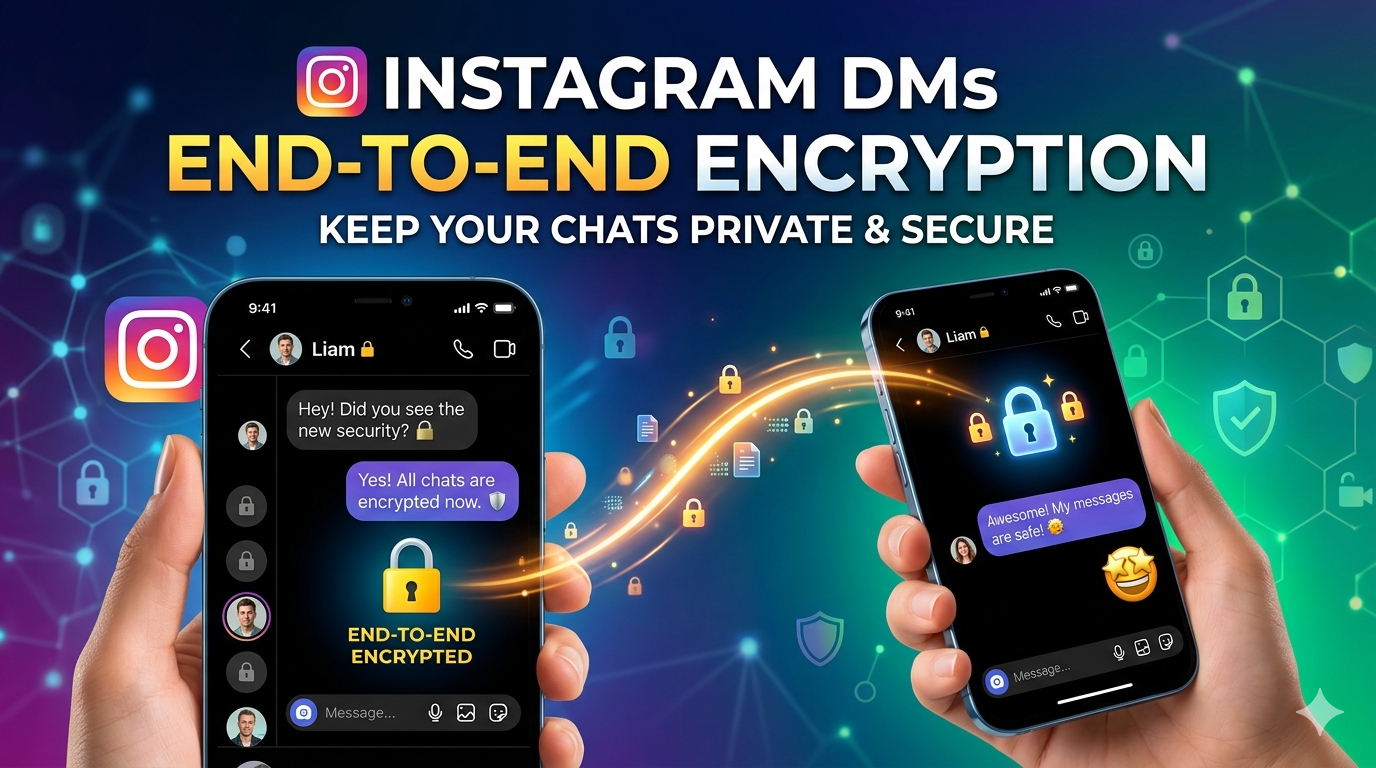
Instagram is expected to change how private messages are protected, with reports indicating that Instagram DMs will lose end-to-end encryption (E2EE) after May 8. If you use Instagram for personal conversations, business support, creator collaborations, or sharing sensitive information, this is a change worth understanding—because end-to-end encryption is one of the strongest privacy protections available in messaging.
This article explains what end-to-end encryption is, what may change after May 8, who’s most affected in the US and UK, what you should do now, and safer alternatives for private conversations.
1. What’s changing after May 8?
The claim: Instagram Direct Messages (DMs) will no longer be end-to-end encrypted after May 8.
If this applies to your account/region/features, it would mean that Instagram DMs may shift to a model where:
- messages are protected in transit (still encrypted between your device and Instagram’s servers), but
- they are not encrypted end-to-end, so the service can technically access message content on its servers in some cases (depending on architecture, storage, backups, and policy)
Important note: Instagram and Meta have multiple message “modes” and feature rollouts that vary by region and account type. If you want, share the source/link you’re referencing and I’ll align the language to what Meta officially announced.
2. What end-to-end encryption protects (in plain English)
End-to-end encryption means only the sender and recipient can read messages. Not:
- the platform
- a hacker who breaches the platform
- a third party intercepting server-side data (in many scenarios)
Think of E2EE like a locked box where only your phone and your recipient’s phone have the keys.
Without E2EE, your messages can still be “encrypted,” but the keys may be managed by the service—making server-side access possible.
3. What you lose without E2EE (practical risks)
If Instagram DMs aren’t end-to-end encrypted, risk increases in scenarios like:
Data breaches and leaks
If attackers gain access to stored messages (or systems that handle them), non-E2EE messages can be more exposed.
Account takeovers
If your account is compromised, an attacker may more easily access message history, media, and sensitive conversations.
Sensitive business conversations
Creators and small businesses often share:
- contracts, invoices, addresses, phone numbers
- client details and disputes
- login/reset links or verification codes (never recommended)
Legal and compliance concerns
If you’re discussing regulated or sensitive topics (health, legal matters), DMs become a weaker channel compared with true E2EE apps.
4. Who should worry most in the US & UK?
This matters most if you use Instagram DMs for anything beyond casual chat:
- Creators/influencers negotiating deals
- Small business owners handling customer support and personal data
- Journalists/activists or anyone facing harassment
- People in sensitive relationships (stalking/abuse risk)
- Teen accounts and parents concerned about privacy and safety
5. What to do before and after May 8 (privacy checklist)
A) Stop sending sensitive info in Instagram DMs
Avoid sharing:
- passwords, one-time codes, backup codes
- ID documents, bank details
- private addresses, travel plans, location screenshots
B) Turn on strong account security
- Enable two-factor authentication (2FA) (authenticator app preferred)
- Use a unique password
- Review “Login activity” / active sessions
- Be careful with third-party apps connected to Instagram
C) Move sensitive conversations to an E2EE-first app
Use Instagram DMs only for:
- initial contact
- non-sensitive scheduling
- public-facing brand communication
Then switch to a secure channel for anything private (recommendations below).
D) Set expectations for customers (for businesses)
Add a short note in:
- your bio
- auto-replies
- Link-in-bio page
Example:
“For private or account-related support, please email us or message on Signal/WhatsApp.”
6. Best alternatives for private messaging (US & UK)
Here are common choices, depending on your needs:
Signal (best for privacy)
- Strong E2EE by default
- Minimal metadata compared to many platforms
- Great for sensitive 1:1 chats and groups
WhatsApp (E2EE by default, widely used)
- Easy adoption in US/UK
- Owned by Meta, but messages are E2EE by default
- Good for customer communication, but consider metadata and backups
iMessage (Apple-to-Apple)
- End-to-end encrypted between Apple devices
- Useful for iPhone-heavy circles (common in US/UK)
Telegram (not E2EE by default)
- Only “Secret Chats” are E2EE
- If you use Telegram, ensure you’re using Secret Chat for sensitive content
7. FAQ (SEO-friendly)
Is Instagram still “encrypted” if it’s not end-to-end encrypted?
Often yes—many services encrypt data in transit and sometimes at rest. But E2EE is stronger because the platform itself can’t read the messages.
Can Meta read my Instagram DMs if E2EE is removed?
Without E2EE, access to content becomes more technically possible (depending on implementation, retention, legal requests, and internal controls).
What should businesses do?
Use DMs for lightweight support and direct customers to email or an E2EE messaging option for sensitive issues.
Does this affect Messenger too?
Meta changes can span products, but features vary. Check the in-app privacy or message settings for your specific account.
8. Key takeaways
- If Instagram DMs lose end-to-end encryption after May 8, privacy protection for message content may be reduced.
- Treat Instagram DMs as not suitable for sensitive information.
- Secure your account (2FA) and move private chats to E2EE-first apps like Signal or E2EE-default platforms like WhatsApp.