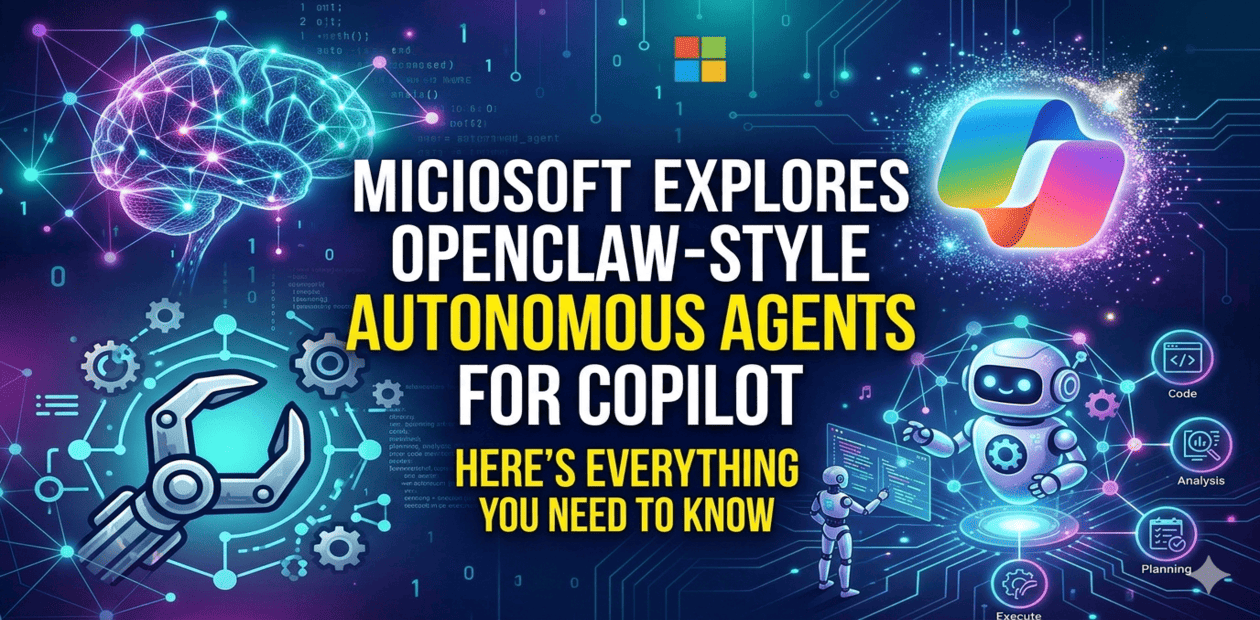
If you’ve been following the AI space in 2026, you already know that autonomous AI agents are the biggest battleground right now. And Microsoft just made its move — a bold one.
According to a report from The Information, Microsoft is actively building OpenClaw-style autonomous agents into its flagship enterprise product, Microsoft 365 Copilot. This isn’t just another chatbot upgrade. This is Microsoft betting its $30-per-user-per-month AI business on a fundamentally new model of how AI gets work done: not when you ask it to, but all the time, in the background, without being prompted.
In this deep-dive, we break down exactly what’s happening, why it matters for enterprise IT teams and knowledge workers, how it stacks up against competitors, and what to watch for at Microsoft Build 2026.
- Microsoft is testing OpenClaw-style always-on AI agents inside Microsoft 365 Copilot for enterprise customers.
- The effort is led by a new team called “Ocean 11” under VP Omar Shahine.
- The agents can monitor Outlook, manage calendars, and execute multi-step workflows autonomously — 24/7.
- Microsoft aims to deliver safer, enterprise-grade controls vs. the open-source OpenClaw project.
- A major reveal is expected at Microsoft Build 2026 (June 2, San Francisco).
What Is OpenClaw — And Why Does Microsoft Care?
The Open-Source Agent That Changed Everything
OpenClaw is an open-source AI agent platform that lets users create autonomous assistants running locally on their devices — not dependent on cloud connectivity or constant API calls. These agents can browse the web, read and send emails, manage files, update calendars, post messages, and complete complex tasks entirely in the background.
What made OpenClaw explode in early 2026 was a simple proposition: AI that actually does things, not just answers things. Frustrated developers and power users who were tired of prompting chatbots found a tool that could act like a real digital employee — monitoring their work, making decisions, and completing tasks while they slept.
Why Enterprises Couldn’t Adopt OpenClaw (Yet)
For all its power, OpenClaw has a serious Achilles’ heel in corporate settings: security. The open-source agent requires deep system access — access to files, emails, browsers, and apps. For an individual developer, that’s fine. For an enterprise managing thousands of employees, proprietary data, compliance obligations, and regulatory frameworks? It’s a non-starter.
Microsoft even publicly noted that OpenClaw is “not appropriate to run on a standard personal or enterprise workstation” — which set up the opening for what comes next.
Microsoft’s Plan: Enterprise OpenClaw, Built Into Copilot
Here’s what Microsoft is actually building, based on reporting from The Information and confirmed details from the company:
“People are hungry for this. Not another chatbot. Not another tool that helps when you remember to ask. An always-on agent that works on your behalf, 24/7, with real access to your real life.”
— Omar Shahine, Microsoft Corporate Vice President
Meet “Ocean 11” — Microsoft’s Secret Agent Team
A small internal group under VP Omar Shahine, informally called “Ocean 11,” is driving this initiative. Their mission: translate the excitement around OpenClaw into concrete, enterprise-ready Copilot capabilities.
What These Agents Will Actually Do
Based on everything reported and confirmed, here’s what Microsoft’s autonomous Copilot agents are being designed to handle:
Microsoft Copilot Agent vs. OpenClaw vs. Competitors
How does Microsoft’s enterprise approach stack up against OpenClaw and other AI agent players? Here’s a direct comparison:
| Feature | Microsoft Copilot Agent | OpenClaw (Open Source) | Anthropic Claude (Cowork) | Google Workspace AI |
|---|---|---|---|---|
| Always-On Autonomous Operation | ✅ Yes (in development) | ✅ Yes | ⚠️ Partial | ❌ Limited |
| Enterprise Security Controls | ✅ Built-in | ❌ Community-managed | ✅ Yes | ✅ Yes |
| Local Device Execution | ⚠️ TBD (possibly hybrid) | ✅ Yes (local-first) | ❌ Cloud only | ❌ Cloud only |
| Microsoft 365 Native Integration | ✅ Deep | ⚠️ Via plugin | ✅ Via Cowork | ❌ No |
| Role-Scoped Agent Permissions | ✅ Yes | ❌ No | ⚠️ Partial | ⚠️ Partial |
| Open Source / Customizable | ❌ Proprietary | ✅ Fully open | ❌ Proprietary | ❌ Proprietary |
| Multi-Model Support | ⚠️ Via Foundry | ✅ Any model | ❌ Claude only | ❌ Gemini only |
| Compliance & Audit Logs | ✅ Enterprise-grade | ❌ None built-in | ✅ Yes | ✅ Yes |
Key trade-off: Microsoft wins on security and governance; OpenClaw wins on flexibility and local execution. If your organization handles sensitive data, Microsoft’s approach will likely win enterprise procurement decisions — even if it launches later.
The Anthropic Angle: Claude Is Already Inside Copilot
One detail that’s easy to miss in all the OpenClaw news: Anthropic’s Claude is already powering part of Microsoft’s agent ambitions today.
In March 2026, Microsoft launched Copilot Cowork — a tool designed to complete long-running, multi-step tasks across Microsoft 365 apps. And it runs on Anthropic’s Claude model. This makes Microsoft’s enterprise AI strategy somewhat unique: it’s using OpenAI’s models at the base level while tapping Anthropic’s Claude for advanced agent workflows, all while studying OpenClaw’s architecture for the next generation.
The Road to Always-On Copilot: A Timeline
-
1 Feb 2026Copilot Tasks Launches
Microsoft releases Copilot Tasks in preview — an AI tool for prosumers to manage email, travel, and appointments. Cloud-based, limited autonomy.
-
2 March 2026Copilot Cowork + Anthropic Claude Partnership
Microsoft launches Copilot Cowork, powered by Anthropic’s Claude. The tool executes long-running tasks across Microsoft 365 apps — a major step toward autonomous agents.
-
3 April 2026OpenClaw-Style Agent Development Confirmed
The Information reports that Microsoft’s “Ocean 11” team is building OpenClaw-inspired autonomous agents inside Microsoft 365 Copilot for enterprise customers.
-
4 June 2, 2026Microsoft Build 2026 — Expected Major Reveal
Microsoft is expected to unveil full details of its autonomous Copilot agent capabilities, including demos of always-on, 24/7 enterprise AI workflows at Build 2026 in San Francisco.
What This Means for Enterprise IT Teams in 2026
If you’re an IT decision-maker, a CIO, or managing a Copilot rollout, here’s what to take away from this development:
1. Your governance framework needs to evolve — fast. Gartner research indicates enterprises typically take 18–24 months to establish AI governance policies. But autonomous agents are arriving in months, not years. If your organization doesn’t have a policy for AI agents with system-level access, build one now.
2. The ROI calculus for Copilot is changing. Today, Copilot justifies $30/user/month through reactive productivity gains — faster drafts, better search. Always-on autonomous agents could multiply that value tenfold, but they’ll also introduce new categories of risk: agents making decisions, sending emails, or updating records without human approval.
3. Security certifications become the procurement key. Enterprise buyers consistently accept reduced flexibility in exchange for audit logs, compliance certifications, and centralized governance. Microsoft knows this, which is why “safer than OpenClaw” is a central pillar of their messaging.
Questions to ask before adopting autonomous agents: Who approves actions the agent takes? What’s the audit trail? Can agents access data outside an employee’s own scope? What’s the incident response process if an agent behaves unexpectedly?
Frequently Asked Questions: