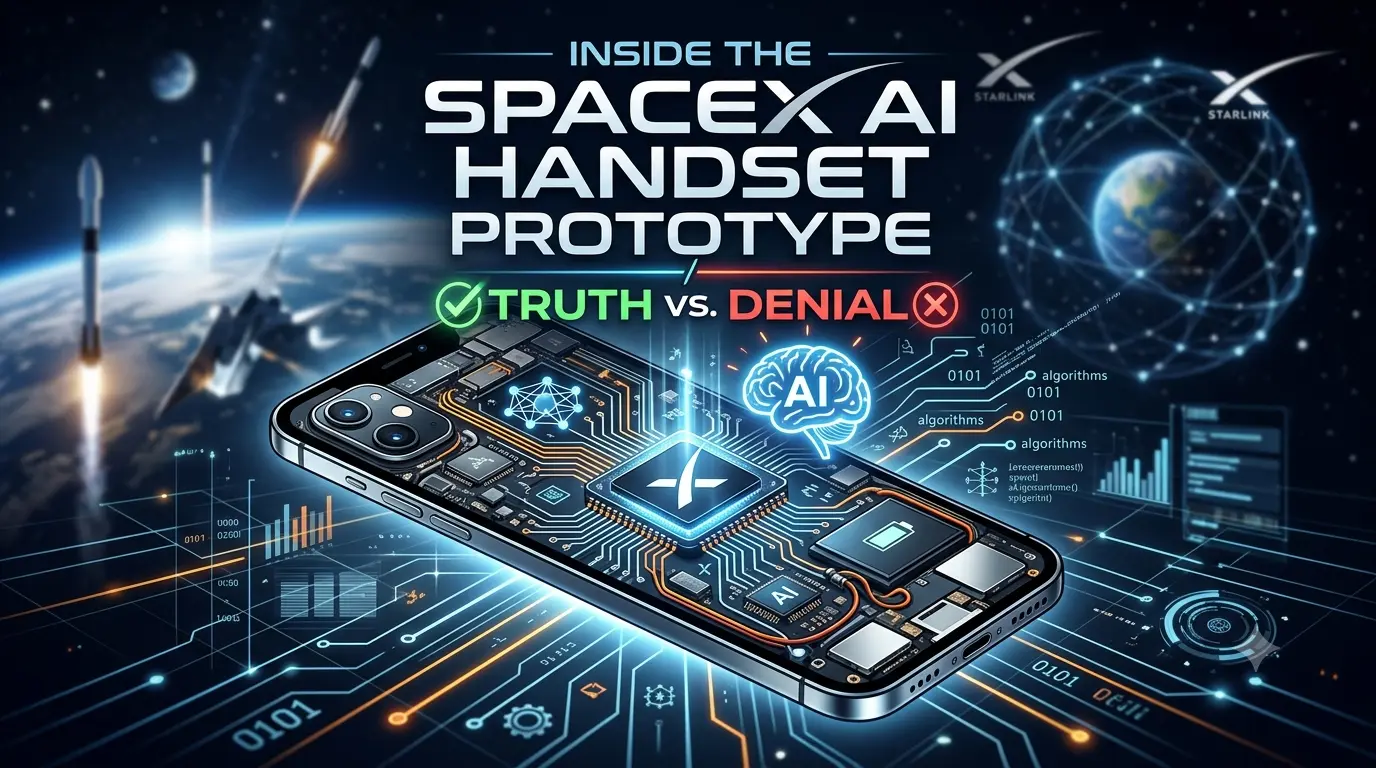
The tech world was upended when The Wall Street Journal broke a massive story: SpaceX had quietly showcased a physical, ultra-slim AI handset prototype to investors during presentations ahead of its massive Initial Public Offering (IPO). The report described an incredibly thin device running a proprietary operating system, powered by Qualcomm Snapdragon silicon, and built entirely around native artificial intelligence models.
Within minutes of publication, Elon Musk took to X with a sharp, two-word absolute shutdown: “Utterly false.”
Despite the flat denial, the markets reacted intensely. Secondary market shares of SpaceX dipped by roughly 7% following the dismissal, proving that investors are fiercely calculating what an independent hardware play means for Musk’s expanding empire.
Whether the physical prototype was prematurely exposed or is a strategic distraction, the underlying structural pieces are already in plain view. By connecting the dots across SpaceX’s ecosystem, the strategic reality of an independent AI device becomes completely clear.
Key Takeaways
-
The Leaked Specs: The WSJ reported a handset-like device slimmer than an iPhone, powered by a custom OS, Qualcomm Snapdragon chips, and integrated with xAI.
-
The Denial: Elon Musk swiftly labeled the report “utterly false,” though historical precedent shows he floats “alternative phones” when platform pressures mount.
-
The Structural Reality: Following the massive $1.25 trillion merger of xAI into SpaceX in February 2026, the company possesses the compute, connectivity (Starlink), and hardware capacity to build native devices.
-
The Market Friction: Skipping iOS and Android allows Musk to bypass the 30% App Store tax on xAI Grok subscriptions and dodge restrictive operating platform gatekeepers.
The Anatomy of the Alleged SpaceX AI Handset Prototype
According to institutional sources briefed on the pre-IPO presentations, the hardware shown was not designed to be a traditional smartphone clone. Instead, it was positioned as a specialized terminal meant to redefine how humans interact with contextual, agentic AI.
| Reported Specification | Technical Implementation | Strategic Motive |
| Form Factor | Slimmer than an iPhone, compact glass/aluminum casing | Differentiates from bulky smartphones; highlights minimalist pocket utility. |
| Silicon Architecture | Qualcomm Snapdragon NPU-centric chipset | Offloads low-latency, on-device AI tasks without draining battery. |
| Operating System | Custom Proprietary OS (Non-Android) | Eradicates reliance on Google and Apple ecosystems. |
| Core Software | Native xAI Grok Architecture | Implements systemic AI agents capable of taking direct user actions. |
| Connectivity | Starlink Direct-to-Cell + Terrestrial LTE | Offers global wireless network reach independent of legacy telecom carriers. |
The choice of Qualcomm silicon is particularly telling. Qualcomm has positioned its Snapdragon platforms heavily around neural processing units (NPUs) capable of running billions of parameters directly on-device. By executing local LLM inference rather than sending every request to a cloud server, a SpaceX device could bypass the crippling latency and connectivity bottlenecks that historically plagued first-generation AI hardware.
The xAI-SpaceX Merger: A Ready-Made Hardware Play
To understand why a SpaceX AI handset prototype is highly credible—regardless of immediate PR denials—one must look at the corporate restructuring that occurred in February 2026.
SpaceX absorbed xAI in an all-stock transaction valued at approximately $1.25 trillion. This shifted xAI from a loose sister startup into a fully integrated business unit within the space and defense giant.
[xAI Inflection Compute] + [Starlink Satellite Constellation]
                      │
                      ▼
       [SpaceX Vertically Integrated AI Engine]
                      │
                      ▼
   [Potential Proprietary Consumer Hardware Layer]
As a result of this merger, SpaceX directly owns:
-
The Compute Layer: Massive sovereign AI data centers running advanced iterations of Grok.
-
The Data Transport Layer: The Starlink constellation, which now controls a massive chunk of global orbital bandwidth.
-
The Spectrum Layer: SpaceX’s aggressive $17 billion acquisition of EchoStar wireless spectrum, combined with its active T-Mobile Direct-to-Cell partnership.
When you control the network, the spectrum, and the artificial intelligence models, the final piece of the puzzle is inevitably the physical terminal in the user’s hand. Relying on an Apple iPhone or a Samsung Galaxy to deliver Grok means handing over data access, ecosystem control, and revenue to competitors.
Escaping the 30% App Store Tax and Platform Gatekeepers
Musk’s friction with Apple and Google regarding app ecosystem dominance is well documented. The economic rationale for building a proprietary AI device traces directly back to platform monetization.
When a consumer subscribes to an AI service like Grok Pro through an iOS or Android app, Apple and Google claim up to a 30% digital cut. For a company operating massive AI infrastructure with razor-thin compute margins, that platform fee eats up vital profitability.
Furthermore, running an AI assistant inside a sandboxed mobile app severely limits its capability. On iOS, third-party apps cannot easily read your screen, manage your notifications, automate your messaging, or execute cross-app transactions. An AI assistant restricted by Apple’s privacy sandboxes is effectively handicapped.
A custom-built operating system gives xAI absolute system-level access. It allows an AI agent to execute complex multi-step workflows—like booking flights, sorting communications, and managing schedules—without hitting an operating system firewall.
Avoiding the Graveyard of AI Hardware Failures
If SpaceX does bring a device to market, it will enter a sector littered with high-profile casualties. The tech industry’s recent attempts at standalone AI hardware have been notoriously difficult:
The Hardware Warning Signs:
Humane AI Pin: Permanently bricked and liquidated in early 2025 after selling under 10,000 units.
Rabbit R1: Suffered a catastrophic drop-off, retaining fewer than 5,000 active users within months of launch.
These devices failed because they asked users to carry an additional, expensive piece of hardware that performed far worse than the smartphone already sitting in their pocket. They were essentially apps forced into low-quality gadgets.
SpaceX, however, possesses an industrial scale that those startups never had. Between Tesla’s massive hardware manufacturing pipelines and SpaceX’s advanced aerospace supply chains, the corporate group understands high-volume component sourcing, thermal management, and lithium-ion batteries intimately. SpaceX has the engineering muscle to build functional hardware; the challenge lies in consumer distribution and carrier adoption.
FAQ: What You Need to Know About the SpaceX AI Rumors
Why did Elon Musk deny the SpaceX phone report?
Musk stated the report was “utterly false,” which could indicate that either The Wall Street Journal’s sources mischaracterized an internal engineering test bed, or that SpaceX is protecting highly confidential IP ahead of its upcoming IPO pricing. Historically, Musk frequently downplays hardware projects until they are ready for formal public reveals.
Will a SpaceX phone replace an iPhone?
If developed, it is unlikely to be an immediate mainstream replacement for iOS or Android. It would likely launch as an premium, enthusiast terminal heavily optimized for hyper-secure communications, global Starlink satellite data roaming, and native xAI agent actions.
How would a SpaceX device connect to internet networks?
The device would utilize hybrid connectivity. It would leverage standard terrestrial cell towers via acquired EchoStar spectrum for urban areas, while switching natively to Starlink’s Direct-to-Cell satellite constellation in remote areas or dead zones, offering truly global coverage.
What is the connection between xAI and SpaceX?
In February 2026, xAI officially merged into SpaceX in an all-stock transaction. This structure gives SpaceX direct ownership over Musk’s AI models, infrastructure, and computing systems, making them the central entity for any future AI hardware developments.