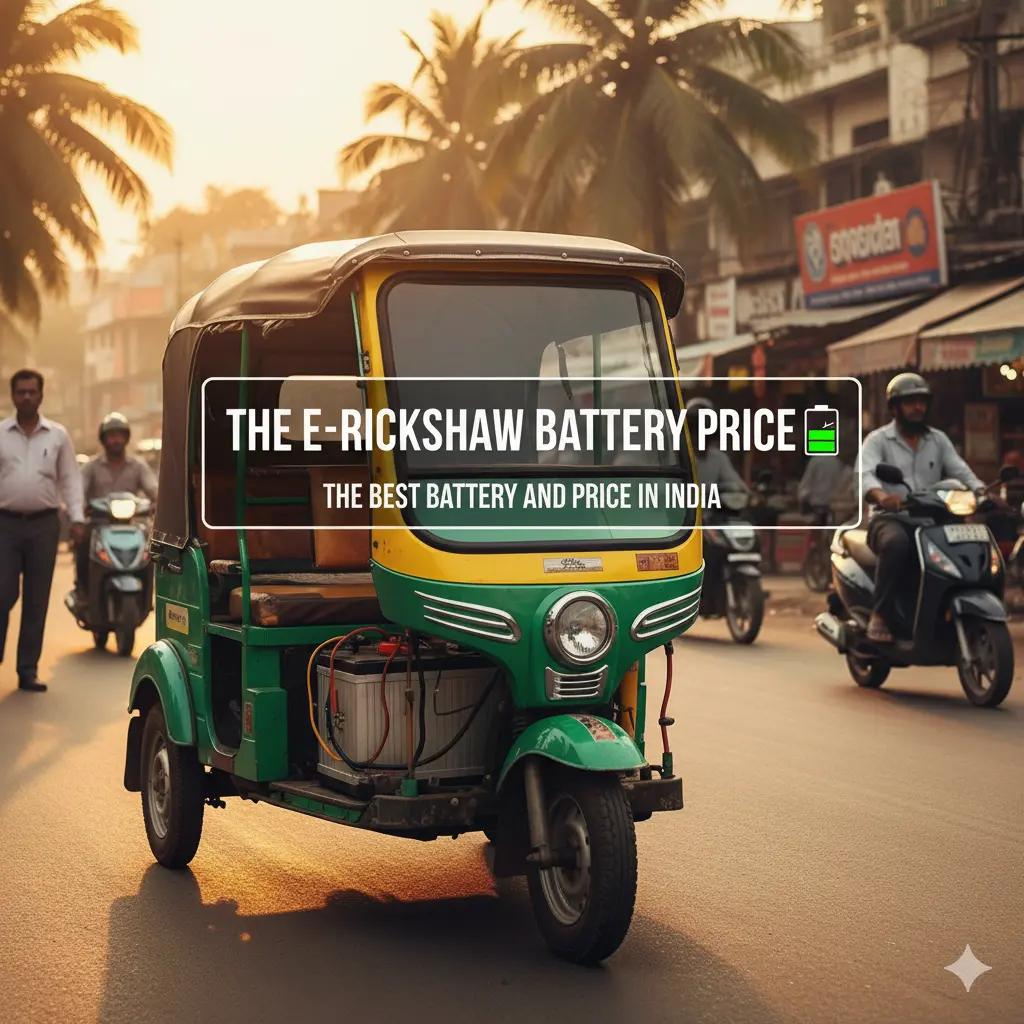
The e-rickshaw segment is the future of urban transport in India. For any operator, maximizing daily earnings and minimizing maintenance costs hinges on one critical choice: the battery.
Choosing the right battery is a long-term business strategy. It determines your vehicle’s range, its uptime, and ultimately, your profit margins. We break down the top choices and the real-world prices you can expect in 2024.
1. Two Battery Technologies: A Head-to-Head Comparison
The market is currently dominated by two battery chemistries. Your decision should be based on your budget, route distance, and Total Cost of Ownership (TCO).
| Feature | 🔋 Lead-Acid (The Affordable Option) | 🔋 Lithium-Ion (The High-Performance Choice) |
| Initial Cost | Low (Lower entry barrier for new operators) | High (Higher initial investment required) |
| Lifespan (Cycles) | Short (Approx. 300 – 500 cycles or 1-1.5 years) | Long (Approx. 1,500 – 3,000+ cycles or 3-5+ years) |
| Charging Time | Slow (8-10 hours, resulting in major downtime) | Fast (2-4 hours, maximizing daily operational time) |
| Weight | Heavy (Adds load, reduces mileage efficiency) | Lightweight (Optimizes vehicle range and speed) |
| Maintenance | High (Requires regular water top-ups and inspection) | Zero (Maintenance-free, managed by a BMS) |
Key Insight: While Lead-Acid is the cheapest option upfront, Lithium-Ion offers a significantly lower Total Cost of Ownership (TCO) due to its longer life and higher efficiency.
E-Rickshaw Battery Comparison Table
While this comparison highlights the 48V standard, the same advantages of lithium over lead-acid apply across other voltage ranges as well, depending on vehicle configuration.
| Feature | 48V Lithium Battery for E-Rickshaw | Lead-Acid Battery |
|---|---|---|
| Voltage | 48V (standard for e-rickshaws) | 48V (standard) |
| Lifespan (cycles) | 2000–3000+ | 300–500 |
| Weight | 25–35 kg | 60–80 kg |
| Charging Time | 2–4 hours | 8–10 hours |
| Maintenance | Minimal | Frequent (water top-up, cleaning) |
| Upfront Cost | Higher | Lower |
| Total Cost of Ownership (TCO) | Lower over time | Higher (due to replacements) |
| Environmental Impact | Low (recyclable, non-toxic) | High (toxic, hard to recycle) |
| Range per Charge | 80–120 km | 50–70 km |
Which is Better for E- Rickshaws:
Performance & Efficiency
Lithium-ion batteries maintain consistent voltage and power output throughout the discharge cycle, ensuring your e-rickshaw doesn’t slow down as the battery gets drained. Lead-acid batteries, on the other hand, suffer from voltage drop-off, leading to a sluggish ride and reduced range over time.
Long-lasting e-rickshaw battery: Lithium batteries last 4– 6 years on average, while lead-acid batteries need to be replaced every 1– 1.5 years.
E rickshaw battery range: A 48V lithium battery for e-rickshaw provides 80– 120 km per charge, significantly higher than lead-acid batteries. This means drivers can cover more distance without worrying about mid-day charging, ultimately leading to more money earned per day.
Charging & Maintenance
Charging Time:
Lead-acid batteries take 8– 10 hours to charge fully, while lithium batteries can be charged in 2– 4 hours. This means that if you switch to lithium, your e-rickshaws will be on the road for longer and generating more revenue.
Maintenance:
Lithium batteries are virtually maintenance-free, while lead-acid batteries require regular water top-ups, cleaning of terminals, and checking for acid leaks. This saves a lot of time and hassle in the long run.
Cost & ROI
Upfront vs. Long-Term Costs:
Lead-acid batteries have lower initial costs but need to be replaced more frequently, typically every 12– 18 months. Over a 5-year period, you could end up replacing a lead-acid battery 3– 4 times, while a lithium battery would last the entire duration.
Total Cost of Ownership (TCO):.
When you factor in maintenance, energy efficiency, and replacement costs, lithium batteries have a much lower TCO.
Electric rickshaw battery upgrade:.
Upgrading from lead-acid to lithium may require a higher initial investment, but the ROI comes in the form of fuel savings, reduced breakdowns, and more operating hours.
Safety & Sustainability.
Safety:.
Li-ion battery benefits also include better safety features, thanks to modern Battery Management Systems (BMS) that prevent overcharging, overheating, and short circuits. Lead-acid batteries are more prone to leaks, acid spills, and even explosions if mishandled.
Sustainability:.
Li-ion batteries are more environmentally friendly, with recyclable components and no toxic lead or acid. Lead-acid batteries, on the other hand, have significant disposal and recycling challenges, posing environmental hazards.
Real-World Pros & Cons.
Lead-Acid Battery Pros:.
- Lower initial cost.
- Easy availability.
Lead-Acid Battery Cons:.
- Heavy and bulky, reducing overall vehicle efficiency.
- Frequent battery replacement with lead-acid batteries.
- High maintenance and risk of acid spills.
- Shorter range and longer charging time.
- Environmental hazards and disposal issues.
48V Lithium Battery Pros:.
- Lightweight, improves vehicle performance.
- Long-lasting e-rickshaw battery (4– 6 years).
- Fast charging and minimal maintenance.
- Higher range per charge.
- Safer and more sustainable.
48V Lithium Battery Cons:.
- Higher upfront investment.
- Requires compatible charger and BMS.
Who Should Choose Which?
Daily, high-mileage drivers and fleet operators: If your priority is uptime, reliability, and long-term savings, lithium is the clear winner. If you are using your e-rickshaw for low-mileage, occasional use, or short-distance trips, and have budget constraints, you might consider lead-acid.
Budget-constrained, low-usage owners: If you can’t afford the initial investment for lithium and only care about short-term costs, lead-acid may be an option. However, you will have to factor in the higher maintenance, more frequent replacements, and shorter vehicle life.
E-Rickshaw Battery Price Breakdown in India (48V System, 2024)
E-rickshaws typically run on a 48V system (four 12V batteries or a single 48V pack). Prices are highly competitive and fluctuate based on brand and capacity (Ah).
A. Lead-Acid Battery Price (Set of 4 x 12V Tubular Batteries)
| Ah Capacity (Per Battery) | Total Price Range (INR) | Primary Brands | Target User |
| 100 Ah | ₹25,000 – ₹32,000 | ABCD | Short routes, low daily running. |
| 120 Ah – 150 Ah | ₹32,000 – ₹40,000 | ABCD | Standard daily routes, better backup required. |
B. Lithium-Ion (LiFePO4) Battery Price (Single 48V Pack)
| Ah Capacity | Total Price Range (INR) | Primary Brands | Key Advantage |
| 50 Ah – 60 Ah | ₹36,000 – ₹48,000 | ABCD | Lightweight performance, moderate range. |
| 100 Ah – 110 Ah | ₹45,000 – ₹75,000 | ABCD | Maximum range (100+ km) and best long-term investment. |
Note to Reader: All prices are estimated and subject to change based on dealer location, local taxes, and ongoing market offers. Always confirm the warranty period (e.g., 5 years for Li-ion vs. 1 year for Lead-Acid).
Critical Factors When Selecting the Best Battery
When making your final purchase, focus on these metrics for the best Return on Investment (ROI):
- Capacity (Ah) & Range: For Lead-Acid, aim for the highest Ah possible (135Ah or 150Ah) to compensate for low energy density. For Lithium-Ion, 100Ah often translates to a comfortable 100km+ range, which is superior.
- Safety & Chemistry: For Lead-Acid, choose Tubular technology for better longevity. For Lithium-Ion, insist on LiFePO4 (Lithium Iron Phosphate) chemistry, which is proven to be the safest and most stable under India’s high-temperature conditions.
- Warranty & Service Network: A long, comprehensive warranty (especially 3-5 years for Lithium-Ion) is a guarantee of quality. Choose established brands with a wide network for easy servicing.
- BIS/AIS Certification: Ensure the battery pack, particularly for Lithium-Ion, complies with the latest Bureau of Indian Standards (BIS) and AIS-156 safety norms. This is non-negotiable for safety and reliability.
The Conclusion: Investing in Uptime and Range
The best battery for your e-rickshaw in 2024 is the one that gives you the highest Uptime and the longest Range. This distinction firmly places the Lithium-Ion (LiFePO4) battery as the superior choice.
While the initial price is higher, the Li-ion battery delivers a 3x to 5x longer lifespan, 2x faster charging, and zero maintenance costs, resulting in substantially higher profits over its entire service life.