RSRQ (Reference Signal Received Quality)

RSRQ is th Reference Signal Received Quality and it can be defined using following. RSRQ= (N* RSRP)/RSSI As per the definition of RSSI, It is wide band power including signal power from serving cell, co-channel neighbour cell, interference from other cell interference and noise, in similar word one can say that RSRQ define the purity … Read more

Signal to Interference and Noise Ratio (SINR)

SNIR is a measure of Signal Quantity and Interference and Noise Quantity and it is very important measurement in terms of RF and sometime it is also called as SNR in absence of interference. It indicate how much desired signal is stronger compare to Noise and interference. Its unit is dB.Mathematical it can be express … Read more

LTE FDD System Capacity and Throughput Calculation

LTE System support for flexible bandwidth like 1.4 MHz, 3 MHz ,5 MHz,10 MHz , 15 and 20 MHz and this bandwidth is the major contributor system capacity. There are some other parameter which affect the system capacity of an LTE eNodeB and given below Channel Bandwidth MIMO Antenna Configuration Modulation Coding Scheme UE radio Condition … Read more

LTE TDD Special Subframe and Its significance for Cell Size

Long Term Evolution (LTE) supports both FDD and TDD Duplex mode. The major difference in TDD and FDD is that in TDD system a single frequency is shared in time domain between Uplink  and Downlink where as in FDD separate frequencies are used for Uplink and Downlink transmission. A TDD frame structure is shown in … Read more

LTE Control Plane and User Plane Latency Calculation (FDD)

LTE- is designed to support peak data rates of 300 Mbps in the downlink  and 75 Mbps in the uplink with 4×4 MIMO support along with C-Plane latency  less than 100ms  and U-Plane latency less than 10ms. Latency is defined as the average time between the transmission of packet and the reception of an acknowledgment. … Read more

Spectral Efficiency : 5G-NR and 4G-LTE

What do you think of when you hear word “spectral efficiency?” The answer will come, it has to do with the amount of information that fits in a given channel bandwidth or one just say how efficiently can that piece of spectrum be used to transmit information. Before we digging into the details of spectral … Read more

LTE Handover Latency Calculation (Access Node)

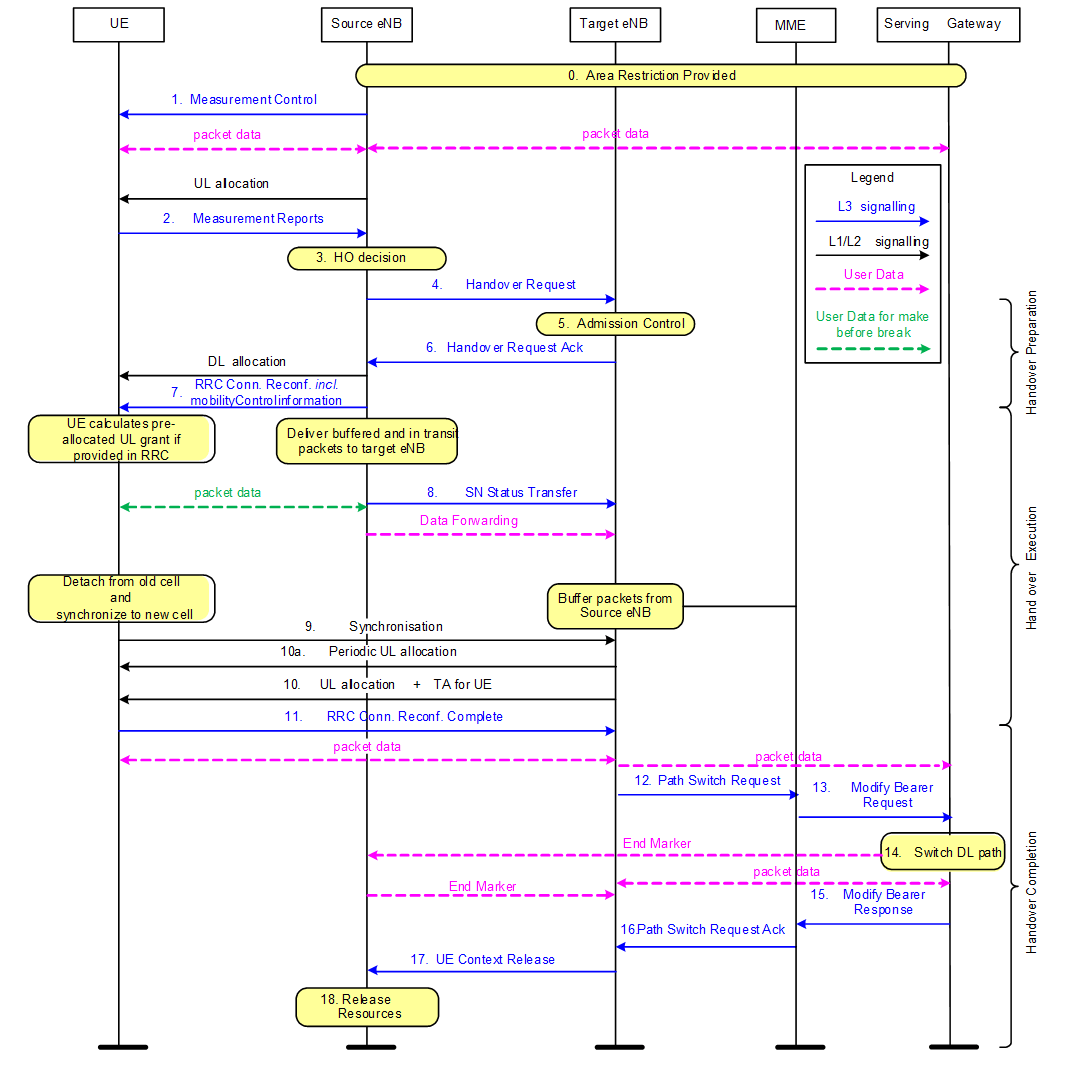
In a cellular system, handover can be defined as a procedure to transfer a User Equipment (UE) and its context from a source cell to a target cell when source cell signal becomes bad so it handover the UE to target cell to continue the UE session. In LTE,  Handover Mobility Support for UEs in ECM-CONNECTED … Read more

VoLTE Cell Capacity- Calculating Packet Size, PRBs and No. of Users

The mobile operators are or have moved to voice over LTE (VoLTE). Globally, voice is still the major chunk of ARPU for the telecommunications industry. However, basic voice may not be enough to remain relevant in an LTE environment which is data services by default, because subscriber communication is shifting from plain voice to HD … Read more

Voice Codec Options for VoLTE Services

The quality of Voice service plays and will play an important role in the evolution of the telecommunication system. Voice subscribers are becoming habitual of Voice over IP (VoIP) services that provide extended audio bandwidth be it Skype or Whatsapp Calling. They also expect the same high quality from mobile voice services. With the maturity … Read more