
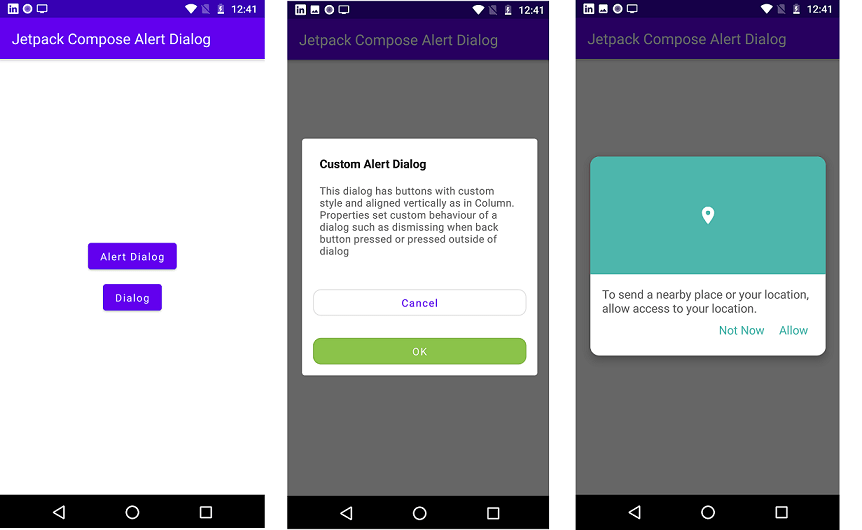
Short answer: in Jetpack Compose you show an AlertDialog by calling it conditionally from a boolean state. Pass onDismissRequest, a confirmButton and, optionally, a title, text and dismissButton. When the state becomes false, the dialog is removed.
Basic confirm dialog
@Composable
fun ConfirmDeleteDialog(
    onConfirm: () -> Unit,
    onDismiss: () -> Unit
) {
    AlertDialog(
        onDismissRequest = onDismiss,
        title = { Text("Delete item?") },
        text = { Text("This action cannot be undone.") },
        confirmButton = {
            TextButton(onClick = onConfirm) { Text("Delete") }
        },
        dismissButton = {
            TextButton(onClick = onDismiss) { Text("Cancel") }
        }
    )
}
Show and hide the dialog with state
@Composable
fun DialogDemo() {
    var showDialog by remember { mutableStateOf(false) }

    Button(onClick = { showDialog = true }) {
        Text("Delete")
    }

    if (showDialog) {
        ConfirmDeleteDialog(
            onConfirm = {
                // delete the item here
                showDialog = false
            },
            onDismiss = { showDialog = false }
        )
    }
}
Compose dialogs are not “shown” by a function call. They exist while they are part of the composition. Keep a boolean (or a nullable item) in state, and call the dialog only when it should be visible. Add import androidx.compose.runtime.getValue and setValue if by remember shows an error.
Add an icon
AlertDialog(
    onDismissRequest = onDismiss,
    icon = { Icon(Icons.Default.Warning, contentDescription = null) },
    title = { Text("Delete item?") },
    text = { Text("This action cannot be undone.") },
    confirmButton = { TextButton(onClick = onConfirm) { Text("Delete") } },
    dismissButton = { TextButton(onClick = onDismiss) { Text("Cancel") } }
)
Dialog with a text field
@Composable
fun RenameDialog(
    currentName: String,
    onSave: (String) -> Unit,
    onDismiss: () -> Unit
) {
    var name by remember { mutableStateOf(currentName) }

    AlertDialog(
        onDismissRequest = onDismiss,
        title = { Text("Rename") },
        text = {
            OutlinedTextField(
                value = name,
                onValueChange = { name = it },
                singleLine = true,
                label = { Text("Name") }
            )
        },
        confirmButton = {
            TextButton(
                onClick = { onSave(name) },
                enabled = name.isNotBlank()
            ) { Text("Save") }
        },
        dismissButton = {
            TextButton(onClick = onDismiss) { Text("Cancel") }
        }
    )
}
Fully custom dialog
When you need your own layout, use the lower-level Dialog with a Card or Surface:
@Composable
fun CustomDialog(onDismiss: () -> Unit) {
    Dialog(onDismissRequest = onDismiss) {
        Card(
            shape = RoundedCornerShape(16.dp),
            modifier = Modifier.fillMaxWidth()
        ) {
            Column(
                modifier = Modifier.padding(24.dp),
                horizontalAlignment = Alignment.CenterHorizontally,
                verticalArrangement = Arrangement.spacedBy(16.dp)
            ) {
                Text("Custom dialog", style = MaterialTheme.typography.titleLarge)
                Text("Put any composables here.")
                Button(onClick = onDismiss) { Text("Close") }
            }
        }
    }
}
Import androidx.compose.ui.window.Dialog. To control dismissal, pass properties = DialogProperties(dismissOnBackPress = false, dismissOnClickOutside = false).
Common mistakes
- Not updating state in
onDismissRequest. If you leave it empty, the dialog never closes when the user taps outside or presses back. - Keeping dialog logic inside the dialog. Hoist state to the caller, as in the examples, so it is easy to test and reuse.
- Creating the dialog outside an
if. It will show every time that code runs. - Using the same state for several dialogs. Use one state value per dialog, or a sealed type such as
DialogState.
FAQ
How do I show an AlertDialog in Jetpack Compose?
Keep a boolean state and call AlertDialog inside an if (showDialog) block.
How do I close an AlertDialog?
Set the state to false in onDismissRequest and in the button click handlers.
What is the difference between AlertDialog and Dialog?
AlertDialog gives you Material 3 slots for title, text, icon and buttons. Dialog is a bare window where you supply the whole layout.
Can an AlertDialog contain a TextField?
Yes. Put the text field in the text slot and keep its value in state, as shown above.
More: Jetpack Compose tutorials and navigation drawer in Compose.